High angling pressure on the invasive northern snakehead (or Chesapeake Channa, as recently renamed by the State of Maryland) has caused these fish to grow wary, and frankly, they’ve become more challenging to catch in recent years—especially for shoreline anglers with less access to unpressured waters as compared to boaters. A few slight adaptations to fishing tactics may just shift the odds in our favor. Remember the days of sitting in a soccer-mom chair on the side of Blackwater’s Key Wallace Drive, soaking minnows and filling a cooler in just a couple of hours? Yeah, me too. But the fishery has evolved, pressure has increased, and the snakeheads have grown wiser. To keep putting up numbers and hooking dragons, it’s time to change our game as shoreline anglers.
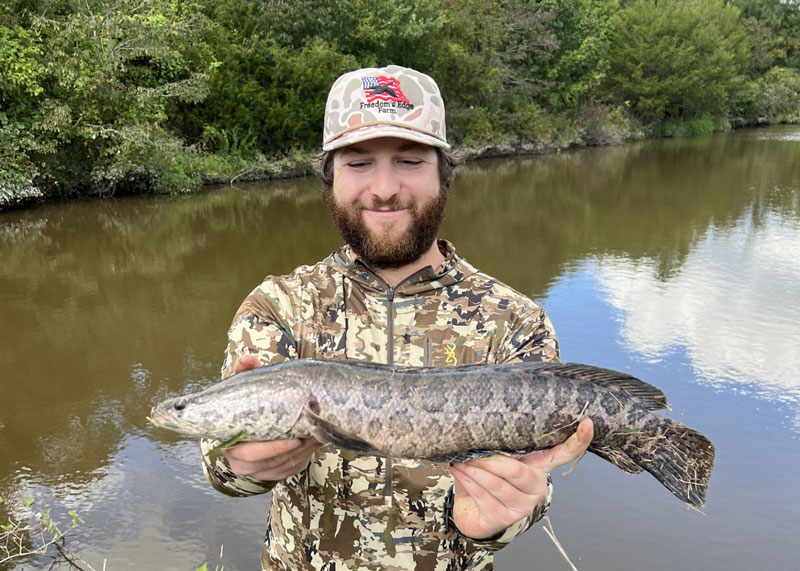
While many of us know that areas like Blackwater National Wildlife Refuge and the tributaries of the Potomac River are absolutely loaded with snakeheads, getting them to eat is a different story. These fish respond rapidly to heavy fishing pressure, meaning they will turn down lures they may have seen before or refuse to bite at all during certain daylight hours.
There are a couple of strategies I employ to combat this skittishness. First, I try to cover as much water as I can to find fish willing to eat. Wasting an hour throwing every lure in your tacklebox at one fry ball is time that could be spent setting hooks on more eager fish. To do this, I “spot-hop.”
Similar to the concept of pond-hopping for largemouth bass, it’s a very effective method for covering water from shore. I’ll load up the car with my rods and gear, and drive around an area where I know snakeheads exist. Each roadside pull-off only needs a couple of casts to know whether or not it will produce. Even if you see fish, if you can’t get them to bite after a few presentations, count your losses and move on. You can always come back to that stubborn snake later to see if he wants to cooperate. And remember, the further you get from popular, highly pressured spots, the more willing the fish should be to bite.
Some places that offer great access for “spot-hopping” are the roads surrounding Blackwater National Wildlife Refuge and the lockhouses along the C&O canal. In Blackwater, there are numerous roadside creeks and cuts that are skinny and provide excellent habitat for snakeheads. On the C&O canal, there are parking lots at many of the lockhouses and miles to roam and fish along the towpath.
Not every spot is as juicy as the next, so there are some important factors to keep in mind before spending too long in one place. For starters, clean water is an immediate turnoff when it comes to pressured snakehead. If they see you your chances of scoring a bite go way down, even if the fish doesn’t swim off right away. I always look for dirty or stained water. Vegetation is keystone cover for snakeheads, so if you see lily pads, grasses, or mats, take some casts. Finally, look for any signs of life. It can be a heron perched on a log, minnows flickering at the surface, frogs jumping into the water, anything. Life brings life, so the presence of other critters means it’s worth taking a cast.
Stealth is another pivotal piece of the puzzle that some anglers overlook when targeting snakeheads from shore. It starts before you even get out of the car. If the spot you plan to fish is right next to the road, turn the stereo down as you approach and park a little ways back from the water if possible. When you exit your vehicle, close the door quietly and do your best to walk softly. Snakeheads can “hear” remarkably well, using their lateral line to detect vibrations. Keep quiet as you approach the spot, and make a long cast. You’ll want to stay as far back from the water as possible so as not to cast a shadow and spook fish. Surprise, these fish can see really well, too.
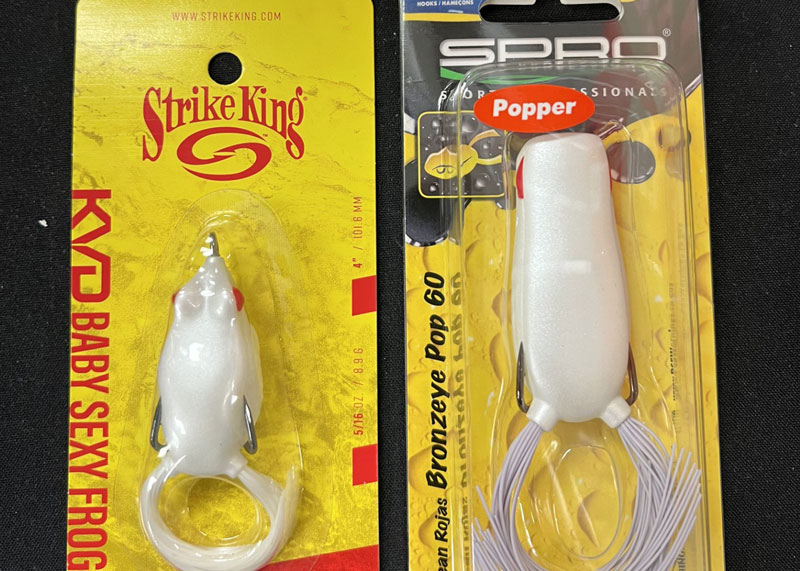
Aside from covering water, adjusting your lure presentation can be just as important. I find myself throwing much smaller frogs nowadays than in years past. It’s not because the spring peepers shrunk, it’s because many of these snakehead have seen enough frog lures to grow suspicious. A downsized offering creates less disturbance in the water and may be less intimidating to a wary fish. Adjusting the way you work the lure is also key to scoring more bites nowadays. Rather than an aggressive walk-the-dog retrieve or hard pops, try slowing way down.
Close your eyes for a minute and imagine a frog hopping from the bank, swimming across the water, and pausing for a rest on a lily pad. Then he kicks off hard, stops for a moment, kicks a couple more times, stops again. I’m serious, close your eyes and picture it!
That’s exactly how I like to work a frog for pressured snakeheads. It takes much more mental energy than say, 10 years ago, when you could regularly cast and straight retrieve an oversized frog beside a grass line and watch it get smoked. Put yourself in an amphibians’ shoes. See the frog, be the frog, and get more bites.
This same principle of downsizing also applies to subsurface lures. When once I regularly threw full-sized chatterbaits and spinnerbaits, I now find myself employing a smaller, more compact presentation. Similar to the concept that aggressively retrieving a large topwater frog may create a lot of disturbance and spook skittish fish, a loud and flashy skirted chatterbait or spinnerbait can do the same. I opt for a 1/8 oz to 1/4 oz weighted 3/0 EWG hook with an underspin, rigged with a three- to five-inch paddletail in white, chartreuse, or purple. The absence of a skirt creates a more streamlined, less threatening profile while the underspin still provides flash and vibration without overdoing it. And of course, use an EWG hook to minimize snagging grass and other vegetation around which snakeheads love to prowl.
One last note on presentation: don’t forget about live minnows. A big, juicy mummichog wriggling under a bobber is about as natural as it gets and can be irresistible to a hungry or territorial snake.
It’s been over two decades since the invasion of Northern snakehead in our watershed, and the mysterious, aggressive nature of these fish—as well as being excellent table fare—has attracted tons of anglers from near and far. With angling pressure comes behavioral shifts amongst a population of fish, and to keep catching them, we must adapt to those changes.
-By Adam Greenberg