It’s June, people, and for countless Chesapeake and coastal DelMarVa anglers that means counting down the days until the opening of cobia season. Cobia are among the biggest, most powerful fish we can target in these here waters, and they taste fantastic to boot. There’s just one problem: there isn’t a cobia aficionado alive who hasn’t spent days at a time gazing across the water while sight fishing to no avail, or reeling in ray after shark after ray while waiting for a cobia to bite while chumming. And unfortunately, when practiced at the ideal time and place for catching cobia, neither of those hero-or-zero tactics commonly result in catching many other species of fish.
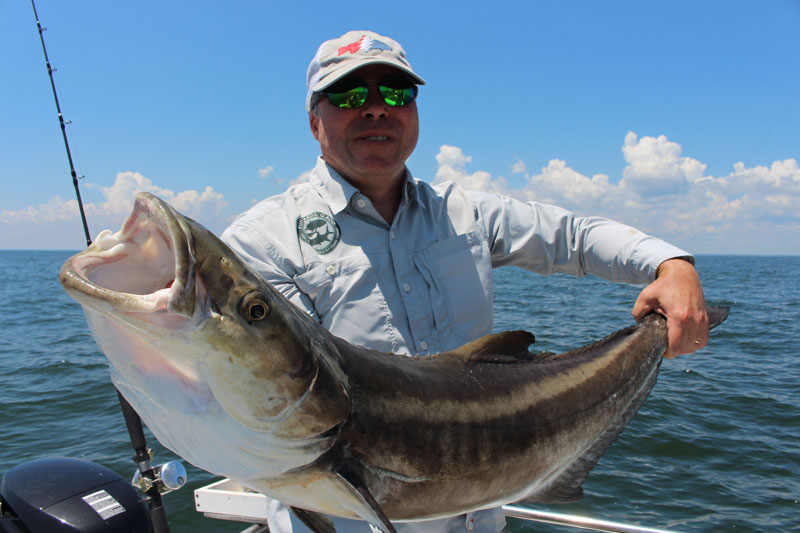
Lucky for you and me, there’s a solution to this cobia-centric conundrum: try trolling with hoses. Stacking the spread with rigs ideal for cobia, only, will produce other fish here and there, but with a little tweaking and cajoling you can seriously boost your chances of catching cobia and then some.
Tempting Cobias with Tubes
For catching cobia and cobia alone you’d offer up only big 24” hoses, mostly in red. While greens, oranges, and whites do catch fish, most seasons red is the dominant producer. So if you’ll be towing six lines (two with #1 planers, two with #2 planers, and two with #3 planers, each about 20’ in front of the hose), five of those would be red and you’d mix in a different color here and there, changing which size planer it was on every hour or two to prospect differing depths with the oddball.
Now let’s juggle the mix a bit more than we otherwise might to try bringing some alternative species into the mix. Adding an additional color will boost your chances a chopper bluefish or a summer striper will take a swipe. Same goes for changing one of those whopping-big hoses for a 12” or 16” tube. So, maybe keep four cobia-centric rigs in the spread and try one line with a different color and a second line with a smaller size. You still have a shot at catching cobia on these rigs, too, but you’ve just significantly boosted the chances of catching a different species as well.
Wait a sec—you just read the FishTalk fishing reports, and learned that Spanish mackerel have showed up in your neck of the woods? Okay, catching a mack doesn’t really stack up to catching a cobia, but it’s a whole lot better than going home with a skunk in the box. Let’s sacrifice one additional line, and put a small spoon on the end. The mackerel will smack it along with the blues and rockfish, adding a little spice to the day. And if it gets hit while the other offerings go un-attacked, you could always trade off the small hose or the odd color and get another spoon into the mix.
TIP: Never fail to tie a ball-bearing swivel midway in your leader and use a second ball bearing at the hoses’s attachment point. Otherwise, the line twist—and its resulting tangle—can be epic.
Speed for Cobia Trolling
With these other lures in the spread you now have a much better chance of catching fish, even if those fish aren’t the target species. The other factor we haven’t addressed, however, is trolling speed. Many anglers differ on what’s ideal for cobia; some say three knots is perfect, while others believe six is the way to go. And of course, plenty of people will advise four or five knots is best.
Truth be told, this is one of those things the fish dictate—not we anglers. Some days moving at a creep catches best, and other days they strike better when you’re moving at more of a clip. Many of us start slow and try bumping it up a bit here or there when the bites aren’t happening. Anywhere within this speed range tends to be fine for adding bluefish to the catch. But if rockfish are around and you want to pick some up, sticking with the slower end of the spectrum is the better move. Conversely, if Spanish mackerel hold more potential, then kicking speed up a notch is more likely to prove effective.
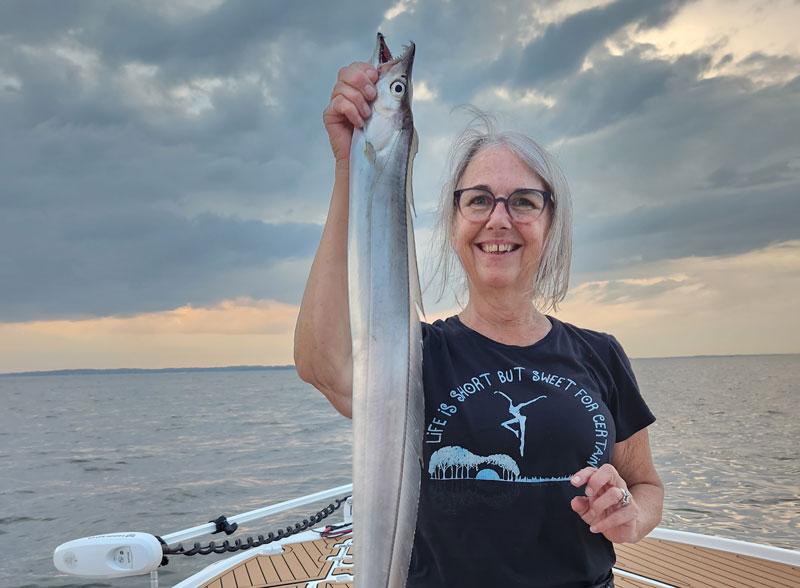
With all those goodies trailing behind the boat you might luck into other species as well—a bull redfish or black drum sometimes slams a hose, cutlassfish have been known to provide a spoon-eating surprise, and in areas where the planers run close to bottom it’s not unheard-of for sea bass or weakfish to grab ahold. And while it’s true that you may be ever so slightly reducing your chances of bagging a cobia by taking this tact, you still have an excellent shot at the big man in the brown suit. And you have an even better shot at enjoying some action from one finned critter or another, whatever species it may turn out to be.
TIP: This entire theory works in reverse, too. If you’re trolling a spread of spoons for mackerel and bluefish, sacrifice one line and put out a big red hose just in case some cobia are around. They often shadow mixed schools of marauding mackerel and bluefish, so this is always a smart move.