It has been said that striped bass fisheries management is a marathon, not a sprint. But if it is, there are hordes of spectators along the route throwing tomatoes and eggs at the participants. Occasionally a rock goes sailing through the air, too. And all the while most of those much-maligned managers are genuinely focused on how to best utilize the resource without destroying it. Unfortunately they’re also running this marathon with their legs tied together, because often all they have to work with is dated science or sometimes, none at all. The current state of the striped bass fishery is a wonderful example of the result.
Meanwhile, recreational anglers, charter fishermen, and commercial fishermen are more or less in a perpetual state of war, often within their own ranks as much as between sectors. Fingers get pointed. Blame gets assigned. Truly preposterous assertions are made, as we saw in the recent battle over catch-and-release fishing during April in Maryland waters. During testimony to the state legislature one captain, who preferred there be no catch-and-release fishing in favor of a longer catch-and-harvest season, claimed that catch-and-release fishing in April was comparable to beating a pregnant woman with a golf club. Wow.
As crazy as some of the arguments become, we all know that solid scientific knowledge is the only way to silence nonsense from all sides. And for years many of us have been begging state and federal authorities to fund the science we need to better understand rockfish, their life cycle, and how human interaction impacts it. Unfortunately, this has not happened—despite the fact that the striped bass is the single most important gamefish on the East Coast. Despite the fact that these fish contribute between seven and 13 billion dollars to the economy annually, and support over 100,000 jobs. Despite the fact that rockfish are the most popular gamefish among coastal anglers from Maine to Virginia. And despite the fact that the striped bass is the official saltwater fish of seven different states. The economic, recreational, and cultural importance of these fish is astronomical, yet they’re still managed with best guesses and assumptions.
That may soon be changing.
SBI in the Sky
Though few of us Chesapeake dwellers knew about it, a few years back while we were arguing over our shrinking pieces of a shrinking pie, an outfit in Massachusetts was applying science to stripers in ways no one had ever thought to try before. The Striped Bass Initiative, a nonprofit research organization funded by the Edwin Barbey Charitable Trust, tried tagging eight adult fish with pop-up satellite (PSAT) tags. These “archival” tags record the fish’s general location, depth, and activity for months at a time. They can’t send out that intel from beneath the water, but they eventually pop free from the fish, float to the surface, and beam the stored data to a satellite.
SBI scientists learned reams of information, showing for the first time that striped bass do travel out to the edge of the Continental Shelf. They documented several complete north-south annual migrations. And they discovered that rockfish come very close to the surface far more often than we previously thought, for much of the year on a daily or near-daily basis.
Wait a sec—if they spend so much time near the surface, would it be possible to utilize tags normally applied to animals that breathe air, like dolphins and whales? Smart Position and Temperature (SPOT) tags can gather far more precise data and transmit it to satellites in milliseconds on a regular basis as these creatures breech. If only there was a way to bridge the gap between the striper’s close proximity to the water’s surface and a clear shot at those satellites…
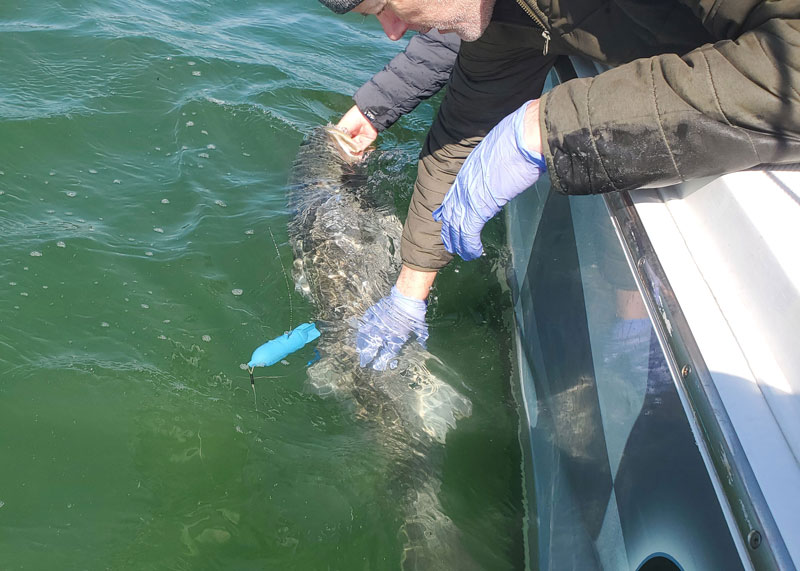
Scientists aren’t always outside-the-box kind of people, but Dr. Brian Prendergast, Research Lead for the Striped Bass Initiative and a Professor for the University of Chicago, came up with an unconventional idea: he tried attaching a SPOT tag to a tether of sorts, which would allow the buoyant tag to bob up and transmit its data every time the fish came close enough to the surface. If the SPOT tag worked in this application, it would allow for monitoring the fish’s location and behavior with far more accuracy and frequency than ever before.
It worked.
By the end of 2025 the Striped Bass Initiative was looking for ways to harness their new tagging technique to generate the most impactful science. They linked up with the Maryland DNR, and asked fisheries managers a simple question: what do you need to know? What critical scientific information would do the most good for the fishery and its stakeholders? Immediately, the impact of spring catch-and-release fishing on the open Chesapeake came up. Did it prevent large female striped bass from completing their spawning runs, or not?
This early spring fishery has tremendous value to guides who want to be allowed to fish (and thus work) at a time when no other fisheries are available to them. It has tremendous value to recreational anglers who simply want to pursue their passion, which means it also has tremendous value to the countless businesses that cater to them: marinas, tackle shops, boat dealers, and more. But the value of a successful spawn is even greater—and any guide or angler worth his or her salt would be quick to agree that if this fishery had a significant negative impact on spawning behavior it shouldn’t take place. If SBI could catch, tag, and release egg-laden stripers, then track their movements and behaviors with precision and frequency, many arguments could be laid to rest.
Striped Bass Initiative in Action
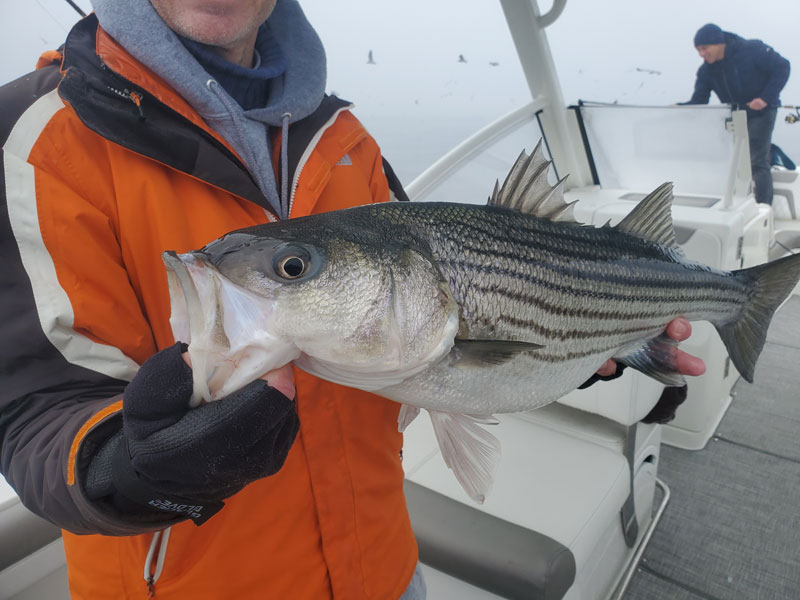
FishTalk was lucky enough to catch wind of SBI and this project, and in late March I joined the scientists to observe and report on their work as they headed out into the open Bay with Griffin’s Guide Service. I watched as Captains Drew Grahame and Gio Gargano caught rockfish between 39 and 45 inches (seven-inch ZMan DieZel Minnowz in Houdini and Mulletron on 1.5-ounce heads were the hot ticket), and Dr. Prendergast and SBI postdoctoral scholar Dr. Caroline Ianniello tagged them with PSAT tags, SPOT tags, and sometimes a combination of both.
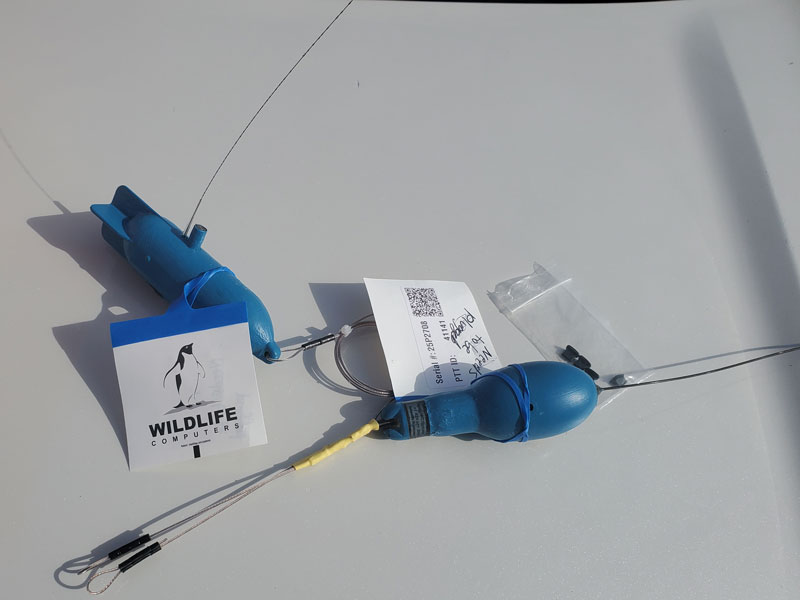
The tagging is quite intrusive as compared to a “regular” catch-and-release encounter. First the fish is set in a large cradle-like bump-board ruler with one person controlling the tail and another holding a wetted chammy over its head and eyes, so the fish remains calm and doesn’t thrash or struggle. The scientists measure the fish’s length, confirm it’s gravid with eggs, and collect scales for aging the fish. Next, a surgical instrument called a trocar is inserted through the fish’s muscle below the dorsal fin, run through to the other side, then removed so a harness (trailing the tether and tag) can be run through the hole. Shockingly, none of the five fish I saw tagged seemed to so much as register the piercing; through the entire 90 to 120 second process they remained amazingly docile.
With the tagging complete, one person holds the tag and leash while another carries the fish to the side of the boat and places it back into the water, maintaining a firm grip on the tail. The fish is then pushed back and forth to pass water over its gills and revive it, but in every case I observed, within moments the fish kicked free and swam off trailing its new jewelry with aplomb.
The scientists were happy, but they wanted more—they wanted the biggest fish possible. And as luck would have it, your (ahem) ever-humble Angler in Chief was aboard. So, after much cajoling and coaxing I agreed to pick up a rod. After giving Drew a sharp elbow and then boxing out Gio, I got into casting position and… BOOM! A 47-incher who we would name Lily was soon aboard. (Well okay, actually I asked permission to take a few casts. Can you imagine how tough it was to watch those guys catch fish while I stood there like some newspaper reporter?! Side note: why do these darn scientists have to measure and document everything? I could easily have claimed she was 50”!)
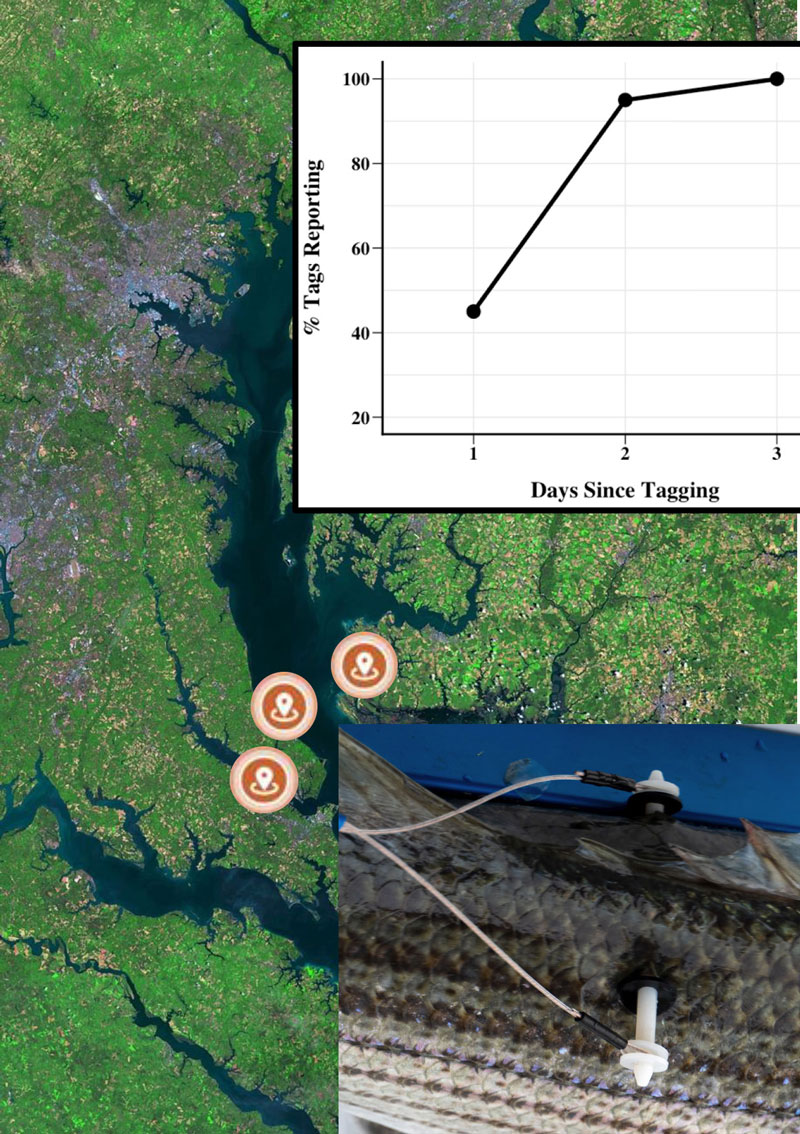
Several days later Lily exhibited pre-spawning behavior, stacking outside of a spawning river. Of the 20 fish that SBI tagged, all 20 demonstrated post-release movements and were signaling within two days of tagging, alive and (seemingly) well. Scientists are still processing the spawning season intel, a tedious task that requires careful parsing of satellite data, but in the coming months some or all will be tracked as they return to their summering grounds in Massachusetts, or Maine, or possibly even Canadian waters.
Soon, the guesses will be replaced with science. Fisheries managers: you can start breathing a little easier. SBI just brought a cooler of Gatorade to this marathon.
The Striped Bass Initiative
The Striped Bass Initiative is dedicated to providing scientific evidence to support data-driven management and conservation of striped bass. Their pioneering science goes beyond tagging and also includes chronobiology and energetics (we have no idea what that means and Googling it made us even more confused). They also study morphological anomalies (we’re pretty sure that means “weird fish”). Their work has been funded to date by the Edwin Barbey Charitable Trust, and we want to say thank you in a big way, EBCT, from we Chesapeake dwellers. But these high-tech tags are incredibly expensive and additional funding would allow SBI to expand and advance their efforts. Donations are accepted via their website and if you know any mega-donor types who love rockfish as much as we all do, we hope you’ll let them know about SBI and this rockin’ cool science.