We finally pulled the trigger at last year’s Annapolis Boat Show: the Rudows got a fishing kayak. I can’t say it’s mine exactly, because my wife provided the main motivation. I generally fish from boats and although I clearly see the advantages of fishing from a kayak in certain situations, have always remained enamored by the feeling of a deck under my feet. She, however, being far less jaded, said it was time to get a pedal kayak. So, we were soon loading a Hobie Mirage Passport 10.5 R into the back of the truck.
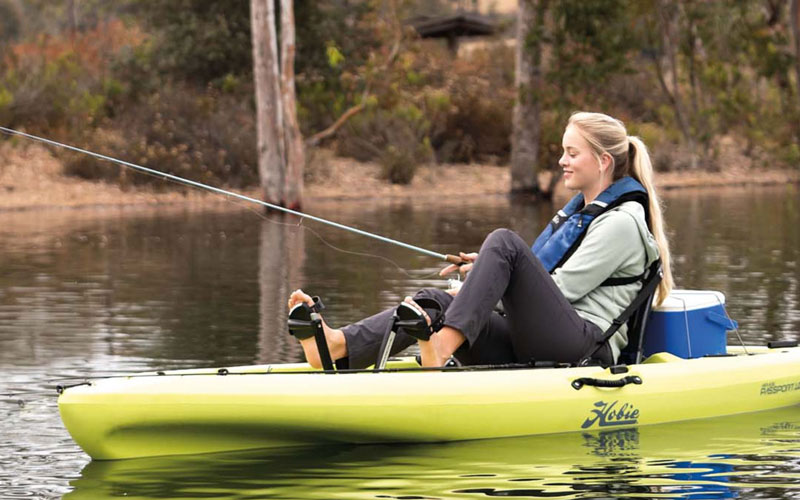
The Passport 10.5 is among the smallest of the dedicated fishing kayaks. It doesn’t have reverse (for that you need to step up a model), nor are there a ton of the integrated features you might find on some larger, more expensive fishing kayaks. But it does deliver that all-important pedal drive to leave your hands free for fighting fish, a pair of molded-in rodholders, a pair of accessory mounting tracks, and a very comfortable aluminum-framed seat. Personally, I love the small size because it minimizes weight, and wrestling 65 pounds in and out of the truck is a lot easier than wrestling 100 or so pounds around for both me and my wife. Critically, it also MSRPs under the $2000 mark.
So, what customizations have I done to it? None. There’s no fishfinder, no additional rodholders, and no high-priced accessories. We opted to get a set of wheels to ease transport, a flag with a light to boost visibility, and a quality life jacket—and still kept the total cost below that $2000 bar.
Construction-wise I have no complaints. The steering system isn’t exactly heavy-duty, but the same can be said of every fishing kayak I’ve seen yet. Multiple parts of the boat include plastic and bungees that need to be protected from UV rays during storage if you expect them to last, but again, that’s the norm for fishing kayaks. The pedal drive seems plenty beefy—my knees are likely to give out before it does—the anchor points are strong, and the rotomolded hull seems as strong as any. We’ve stacked kayaks on several trips (including one six-hour haul) without causing any damage.
Sure, we give up a bit when it comes to size and capability, but the simple, unmodified Passport is great for fishing ponds, lakes, and creeks with shallow depths; working piers along a shoreline; and straightforward drift fishing. Kayak trolling is possible but only in a handicapped sense, because there are only two rodholders and they’re both behind the seat. You can pull two lines and wait to feel for the added resistance of a fish (while perpetually craning your neck to get a glimpse of a rod tip) and/or hold a rod in one hand, but it certainly isn’t as effective as having a kayak fitted out for the task. It’s also tough to hold position without reverse, which makes fishing vertically over structure or channel edges frustrating at best and a longshot at worst. Of course, without a fishfinder, locating such things are a longshot in the first place.
All of that said, I’m 100 percent satisfied with the Passport—and then some. If I know trolling will be in the cards I’ll tow the little boat, instead. If I want to fish bigger waters or park over structure I get on the big boat and hit Spot Lock.
If you’re looking for a kayak that gives you the most versatility as an angler, you don’t have a bigger boat that you can jump on whenever you like, and 90 percent of your angling will take place via kayak, the unmodified Passport 10.5 probably wouldn’t be the best pick for you, personally. But if you plan on being a casual kayak angler, you want to keep things light and easy, and you don’t want to break the bank, this simple little rig will be a great option to consider.