Fiberglass boats are great for the average recreational angler running a center console boat, but have you ever noticed that the serious professionals like commercial fishermen, marine construction workers, and SAR personnel, prefer aluminum builds? There are a number of reasons why: aluminum doesn’t shatter upon impact, aluminum boats can be custom-built to meet your exact demands, and they can take workhorse-like loads along with excessive use and abuse without taking damage. These are also the top reasons why someone who’s seriously nautically inclined might opt for a Hull Boss, a boat we ran recently and shot some video on.
Hull Boss boats are custom-welded in Southern Maryland, by Phelps Brothers Welding, a family-owned operation that’s been around for over a decade. One of the coolest things about their custom creations is that no two are the same. As Hull Boss puts it, “Your needs shape our designs.” You want a multipurpose center console with a T-top? You’ve got it. You need a foredeck with stowage underneath? No problem. You want a wide-open deck with room to stack one bushel basket after the next? Done.
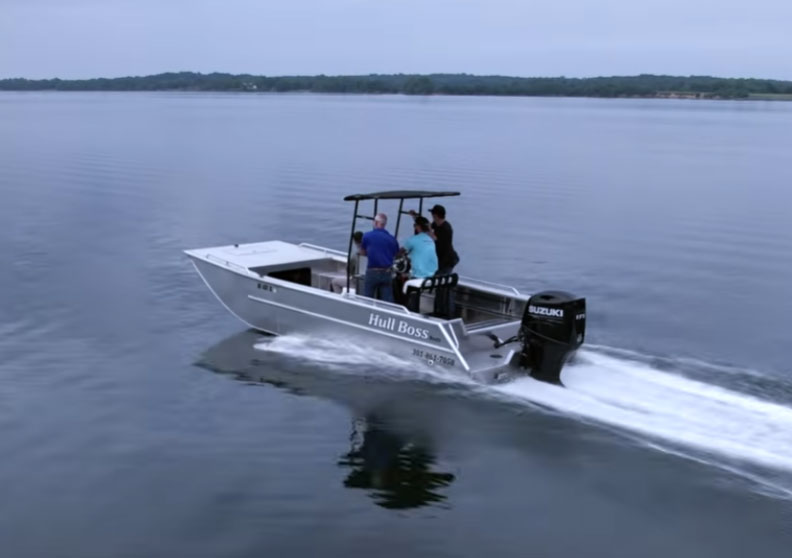
The model we tested was a 21-footer, powered by a Suzuki 175. Designed to meet the needs of a working waterman, it was built with a rather eye-opening 0.250” thick hull bottom. Yes, you read that right. Look up the specs on most 21’ recreational aluminum boats and you’ll see a hull thickness of 0.10” or 0.125”—the Hull Boss is literally twice as thick. And if you could yank the deck off those recreational boats and compare the two stringer and bulkhead structures you’d also see quite a bit more beefiness in the Hull Boss’s structural support. The bottom line? Whether you’re running full-tilt and a partially submerged log gets in the way of the hull or you’re stacking thousands of pounds of blue catfish on the deck, the chances of damaging this boat are exceptionally remote.
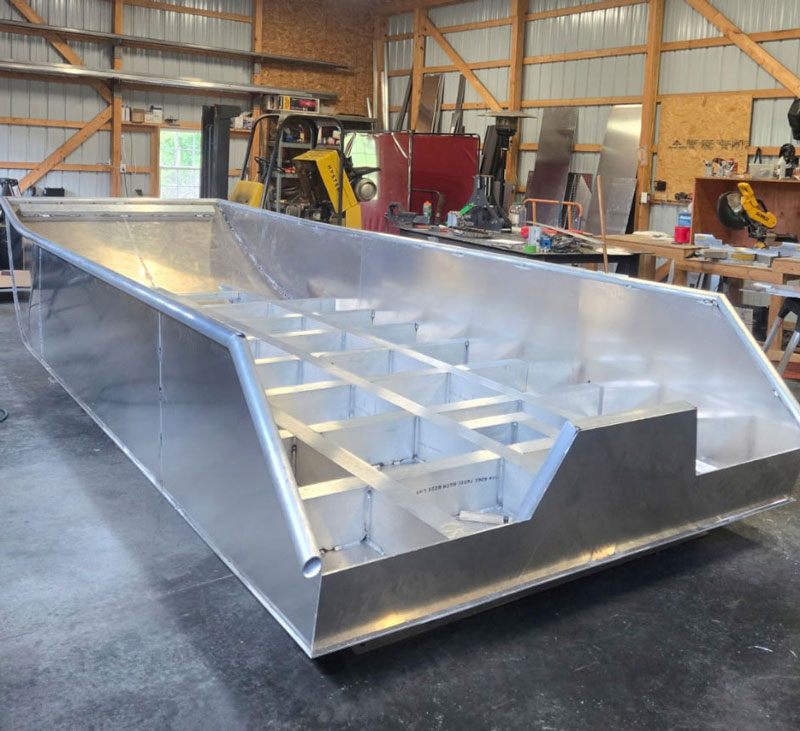
There’s an added bonus to this sort of construction, too, in its seakeeping abilities. When we tested the Hull Boss the Patuxent River was calm, but we hit plenty of boat wakes and thanks to all that heft, the usual beating associated with running aluminum boats across the waves was absent. Mariners who have experience on aluminum rigs will walk away impressed after a sea trial.
With that 175 on the transom performance was eye-opening, too. Set at a mellow 3500 rpm we cruised along at 25 mph. At 4500 rpm cruising speed was right around 35 mph. And when we opened up the throttle we zipped along at 46 mph. That was with four people aboard plus fuel and video gear, and the builder told us they’ve broken 50 when they had a lighter load.
If you might be dropping a 10-pound trot-line weight to the deck (oops!), bouncing off of rocks (oops, again!), or tossing mountains of mammoth catfish on the deck (yay!), this boat is going to be a top pick. For those who demand commercial grade, there is indeed a new boss in town.
For more information contact Hull Boss, Nanjemoy MD, (301) 861-7058.