Where are the white perch? That’s a question we’ve heard over and over again for several years running. You don’t have to be an old-timer to remember when white perch were so plentiful that catching them by the dozens was easy all summer long. And all spring, all fall, and most of the winter, too. Those days appear to be over in some—though not all—areas of the Bay.
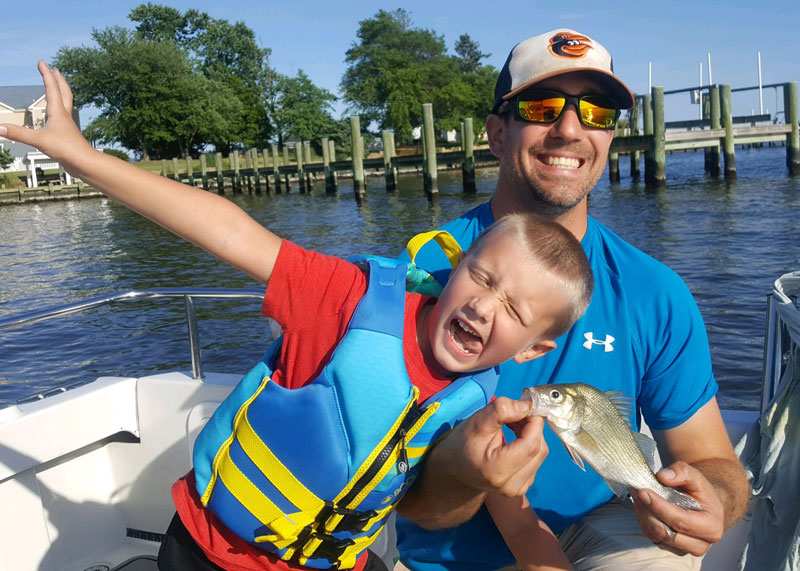
Five or so years ago we began hearing from readers (see our Letters section this month for the latest), and experiencing for ourselves, how much more difficult perch fishing had become in the Upper and Middle Bay zones. And for the last couple of years there’s been plenty of chatter on the topic. Yes, you can still catch white perch, and in some areas of the Bay you can still load up on them at times. But judged on the whole there seems to be little doubt that their numbers are suffering in several large swaths of the Chesapeake.
An interesting anecdotal factoid: last season when people did encounter a pocket of white perch, they often reported catching large 11”, 12”, or even 13” fish. In other words, these perch were quite old, and likely hatched during the last big spawning year reflected in Maryland’s young-of-year survey in 2018. The years 2019, 2021, and 2025 were right around average, but 2020, 2022, 2023, and 2024 were well below average. In Virginia waters, setting aside 2023 (which showed excellent results in the Rappahannock and the James Rivers), the white perch young-of-year surveys have shown similar results.
This shouldn’t come as a huge surprise. We all know how dismal the rockfish spawn has been, white perch share many similar biological and spawning traits, and they face the same environmental challenges. While their recruitment results tend to shadow each other, however, white perch results do seem to have fared better than rockfish overall.
So, why aren’t we seeing more fish? It’s an open question, but one possibility springs to mind as a likely factor: they have to run the gauntlet of predators that crowd the spawning rivers, which now includes the voracious blue catfish. And unlike rockfish, white perch don’t get large enough to shrug off those big blue cats at any point in their life.
I don’t like the thought of adding restrictions to what we recreational anglers can and can’t catch and harvest. We already fish under a blanket of regulations that are restrictive, confusing, often feel overwhelming, and sometimes seem confounding. That said, we know that right now there are few limits on harvesting white perch anywhere in the tidal waters of the Chesapeake. We know that blue catfish like eating white perch—a lot—and focus on them as a food source when the perch are making their spawning runs. We know that environmental conditions do not seem to be improving significantly over time. And it might be wise to consider if it’s time for some sort of conversation about this situation.
Does anyone out there really need to load a stringer or livewell with more than, say, a dozen white perch? Does a commercial harvest that has regularly exceeded a million pounds, in 2012 exceeded two million pounds, and almost always exceeds 500,000 pounds—in Maryland alone—seem appropriate at this time? (Note: the most recent figures on white perch harvest available online are from 2014; I requested current figures from the DNR but did not receive them after repeated attempts). As for the blue catfish issue, it does seem that the powers that be are attentive and taking whatever actions they can. But when it comes to environmental issues, what more can we do to restore water quality and spawning habitat?
I don’t have the answers to any of these questions. But I’m pretty sure we need to start asking them.