Quite a few kayak anglers have electronics on their boat today, some even with real-time imaging sonar. But what about those of us who can’t or don’t want to invest in those rather expensive devices? What are we to do? Well, we go old school. We look at the weather, read the water, and use knowledge gained from years of fishing without electronics. We’re trying to avoid blindly casting in the hope of lucking into a fish.
Starting with the weather, look at wind direction and warm or cold fronts moving into the region. Unstable weather will affect fish activity. When you have a stable period and the weather hasn’t changed much over a few days or weeks fish activity will remain stable as well. That is, if you’re catching fish in a particular location or pattern the fish will most likely remain in that pattern for several days. On the other hand, patterns will often change after unsettled weather.
After a high-pressure system has moved in and you have blue skies it can mean poor fishing. This is the time you should present reaction baits such as crankbaits, jerk baits, and spinner baits. Keep in mind that if you have wind on a blue-bird sky day the wind may break the water’s surface, allowing fish to rise and seek shallower water. Wind can make fishing difficult, but it can also be beneficial. A wind blowing on a cold sunny spring or fall day will push warmer surface water against the shoreline, attracting bait and game fish. Wind blowing across a point will do the same and also provide currents with oxygenated water. I always look for pinch points, points of land, shorelines, and guts that are being affected by the wind. These areas will often hold a fish or two regardless of other weather factors.
Moving away from weather, let’s look at the shoreline. Casting along a shoreline in the dead of winter or on a hot summer day may not be productive due to water temperature being too uncomfortable for the fish. Then again, on a warm sunny winter afternoon, fish may be up shallow trying to soak up the sun. Or, on a hot summer bluebird sky day fish may be in the shade of a tree. Not only do fish seek out shade during the heat of summer, but in freshwater areas fish may be feeding on bugs that fall on the water.
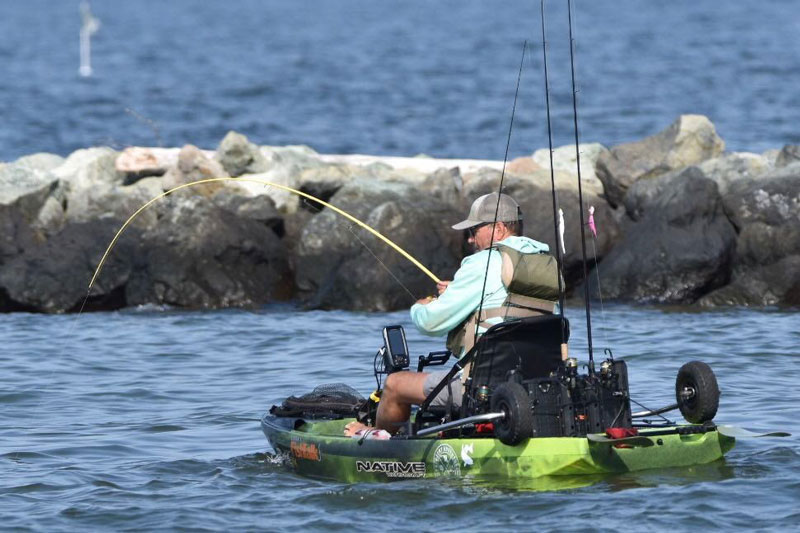
Riprap is also a productive shoreline for taking a cast or two. The rock provides spaces for baitfish to hide and feed and they in turn provide food for sport fish. On a sunny but cold spring or fall day the rock warms quickly, bringing fish in to seek warmth and to feed. Changes along the shoreline from stone to sand or to dirt or a grassy bank attract fish for feeding on insects and bait fish that are attracted to these changes in zones.
Shallow flats are always a good choice to take a cast over. Wearing a good pair of polarized sunglasses is beneficial for this type of fishing, where you may see fish moving from one grass patch to another. That should be a great place to work a jerkbait over or along the grass edges.
Stump and lily pad fields, along with laydowns, are also good choices to take a few casts around, through, or against. Casting a spinnerbait or square-billed crankbait in and around stump fields and laydowns can produce fish. Or, tossing a plastic frog or plastic worm rigged weedless can generate a bite in a lily pad field.
Once you find a pattern for the bite of the day, take note of the conditions. You can apply it to other areas on the lake, bay, river, or creek. All the while you are building a memory of these conditions to be used on future outings. So get out there and take a cast, but not a blind cast—use your experience and knowledge until you find that pattern for the day, the old-school way.
-By Eric Packard