Few people ever try recreational oyster tonging, which shouldn’t come as much of a surprise. It happens during the coldest months of the year, it can be a challenge to locate nearby public oyster bars, and then there’s the matter of wrangling up a set of tongs. Oh, and did we mention just how much physical work is involved? Lowering and raising the tongs through 10-plus feet of water is difficult, and raising them up full of shell is back-breaking.
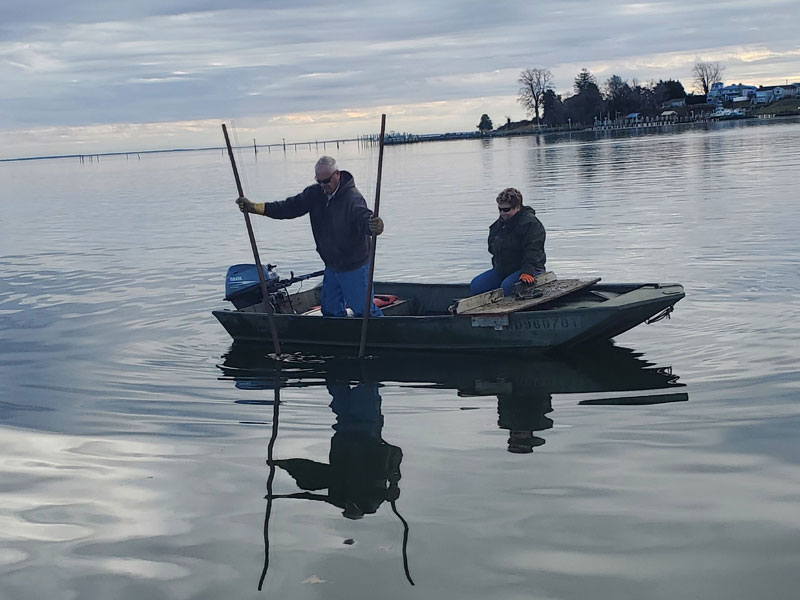
So, why consider recreational tonging? First off, it’s an illuminating experience. You’ll discover all sorts of little fish and crustaceans that are living in and on the oysters. You’ll get a taste of what it would be like to earn your living by working the water. And you’ll gain a much better understanding of just how hard it can be to get a tasty oyster from the bottom of the Bay into your mouth, when you go through the process from start to finish rather than swinging by the raw bar or seafood store. For these reasons—and to get out of the house in the middle of the winter—when my kids were young I took them tonging once or twice a season. Although it was always frigid and none of them were very interested in eating oysters, it was always a fun and valuable experience.
Oyster Tonging, 101
Tonging is quite simple once you’ve found some oysters (that’s the hard part). Just anchor your boat, hold the tongs vertically, and lower them hand-over-hand until they reach bottom. Then swing the handles open just like a giant pair of scissors, lower a bit more so the open rakes just scrape bottom, and pull them closed. Give a gentle shake, and if there’s shell and/or an oyster or two in there you’ll feel it bouncing around. With practice, you can feel the difference between whole oysters and bits of empty shell.
At this point you can raise the tongs up hand over hand until the rakes reach the surface, or you can use the waterman’s trick of opening the rakes, shifting the handles left and right, and raking several times as you rotate the tongs. This allows you to gather a pile of shell in one spot. Then, you can try to scoop up the pile and raise it to the surface all at once.
In years past when there were numerous oyster “rocks” (clusters of oysters all growing together) it might have been necessary to bang the tongs on bottom as you raked, to break up the oysters for gathering. These days it’s rare to find an oyster rock like this in a public area, but if you feel the rakes bounce off hard, rigid bottom and come up empty, it’s worth a try.
Finding Public Oyster Bars
As we mentioned, the hardest part of tonging is usually finding a good public spot close to home in the first place. There are Maryland oyster bar maps and Virginia oyster bar maps showing the locations of public bars and open harvest grounds. However, just because an area is designated as a public bar doesn’t mean you’ll find any oysters there. Many are sparse, and many more are barren. You’ll need to find a good spot either through word of mouth, or by setting out and testing the waters one spot after the next. For a frame of reference, back in the day I tried six or seven spots in the South River and Thomas Point area before finding one productive area.
Finding Oyster Tongs
Coming up with a pair of tongs can be challenging. Few of the craftsmen who still make them today advertise, so local knowledge is usually a must to find them. James E. Harvey Millwork in Bozman, on Maryland’s Eastern Shore, which produces shafts of varying sizes, is an exception and can be found online. All the usual online marketplaces are also an option, though you should expect that it may take some digging and some time before hitting paydirt. If you’re handy you can do some research and make your own shafts. As for rakes, you can often find a pair in the many antique stores dotting the Bay’s shores (which is how I’ve found several).
Remember that short “nippers” of just eight or 10 feet won’t reach bottom in many of the best tonging areas. But on the flip side of the coin, very long tongs are heavier and unwieldy. I’ve found 16’ to be the most I want to handle, and long enough to reach most of the productive zones in my area.
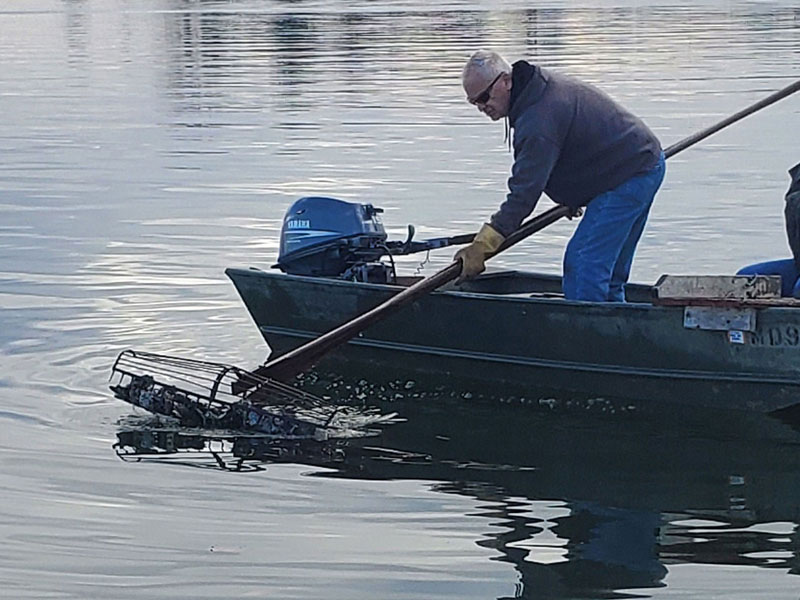
Fair warning: tonging oysters is a messy business, and mud and shell bits will get all over your boat. Still, it’s an experience not to be missed by those who love the Bay and appreciate its many mysterious creatures. When you pull up empty “boxes” (open oyster shells that are still connected), be sure to look inside. This is often where you’ll spot little crabs or fish like skillet fish, gobies, and blennies, which are rarely seen by the average angler. And after the experience be sure to return the shells of any oysters you harvest back into the water, because that’s what baby oyster spat will attach to and grow on next season. And, who knows? Maybe you’ll have so much fun recreationally tonging for oysters that you’ll be doing it again next winter to see those new baby oysters for yourself.
Responsible Oyster Harvest
Recreational harvest of oysters is fun, an interesting experience, and of course many of us love eating fresh oysters. That said, considering the radically reduced population of wild oysters in the Bay as compared to historic levels, moderation in the harvest is certainly a concern. In Mayland you’re currently allowed 100 oysters per person per day, Monday through Saturday from sunrise to noon, with a recreational oyster license. In Virginia you’re allowed a bushel (with no special license required) seven days a week. Of course, just as we might catch a fish that would be legal to harvest and instead return it to the water, nobody says you have to fill your limit. For many of us, taking a dozen or two oysters home for dinner will be plenty.