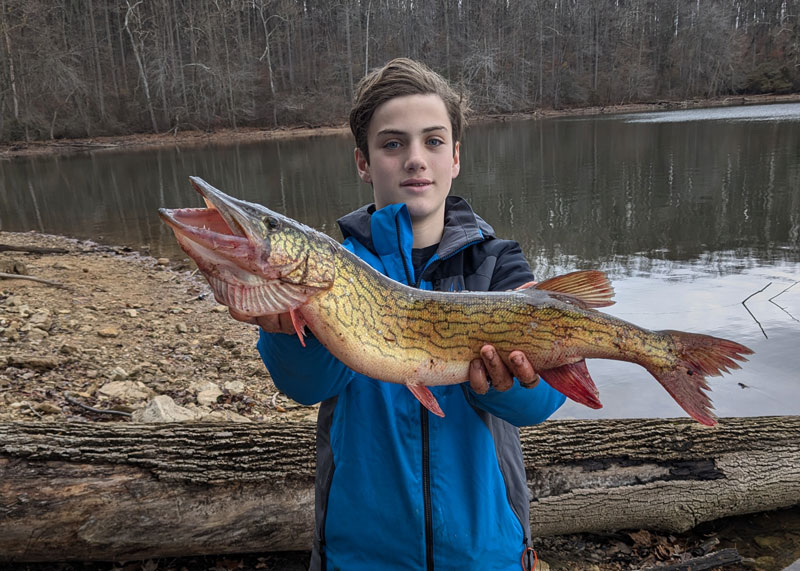
Whether you're hoping to tie into crappie fishing from the shoreline or you plan on tying into some bass, many of us spend enough time walking reservoir shorelines to get from here to Florida and back. Especially when the salty zones of Chesapeake country are quiet, hitting reservoir shorelines is an option that has constant appeal—and the potential for catching big fish.
How to Fish From the Shorelines of Reservoirs
As with all types of fishing, there’s more than one way to skin a cat and you might find it effective to fish with Lure X or Method Y. Many will find, however, that it’s extremely tough to beat casting out a live shiner when reservoir fishing during winter. If you’re hoping to pick up crappie or white perch stick with smalls; yellow perch like mediums the most; and apex predators like bass, pike, and walleye generally like larges.
Rigging can be as simple as it gets. An eight- to 12-pound class spinning rod works well for this task and when using mono line you don’t even need a leader unless pike, pickerel, or walleye are the target, and can tie a hook directly onto the end of your line. If toothy fish are likely in the mix, a couple feet of 15- or 20-pound fluorocarbon will minimize the bite-offs (as will choosing a long-shank hook). About two feet up from the hook, add one to three large split-shot depending on how far you need to cast to reach the desired depth range. Half- or quarter-ounce rubber-cores work just fine, too, but remember that using minimal weight will provide the least resistance for a fish to feel when it snaps up the bait.
The way you fish these rigs is simple, too—just cast ‘em out, and let ‘em sit. Some slack drooping off the rod tip is a good thing, and if the wind and wave action allows for it, leave your bail open and simply watch the lines. If not, make sure there’s some extra slack and leave the rod sitting with a loose drag. When a line starts going taut and begins moving away pick up the rod, point the tip towards the fish, reel tight, then set the hook.
When you aren’t having much action check the baits every hour or so to make sure the shiner hasn’t died or managed to wiggle off the hook. But try not to check too terribly often because an average shiner is only good for two or three casts before it dies.
Choosing the Best Fishing Spot from the Shoreline
Any of the reservoirs in our area can be effectively fished from shore, from the Baltimore area lakes out to Deep Creek down to Kerr. The one potential showstopper for the northern and western lakes is, of course, ice. Even a skim is enough to shut you down, and an ice shelf five or six feet from the shoreline can be enough to prevent you from landing a fish even when you do hook one up. So at times, part of the “where” you’ll need to consider will be where there’s ice and where there isn’t.
That said, don’t let a little freezing weather stop you. These reservoirs wind and turn and some portions will get blasted by the wind while others may not, so quite often when half the lake is frozen, half of it isn’t. In some other cases areas around bridges can provide an opening—literally—thanks to the warming effect of the pilings plus salty runoff from the roadway.
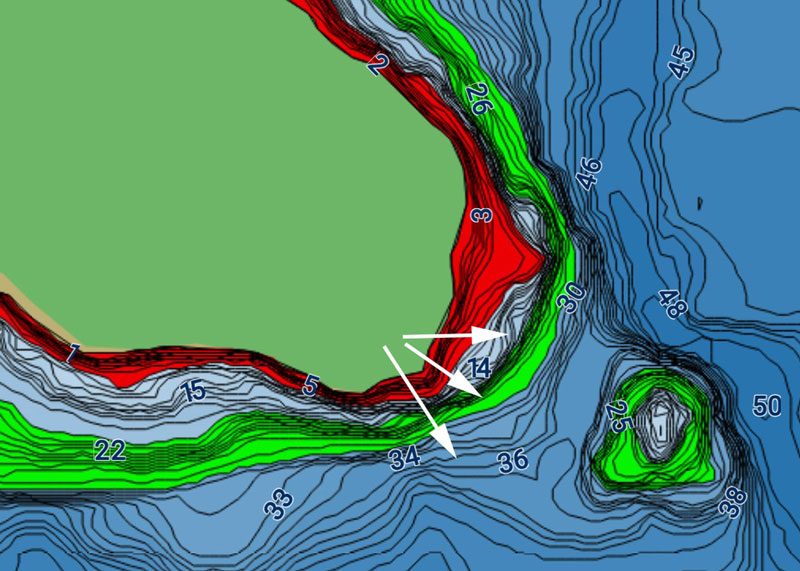
Assuming your choices aren’t severely limited by ice cover, looking for areas with access to deep water within casting distance is often a key. That’s not to say that you’ll only catch fish down deep (though this often is the case during the colder months of the year) but during the chill of winter even when fish might move shallow to soak up the afternoon sun, they’ll do so where they can get back to the depths with a few pumps of the tail. What this often boils down to is fishing points.
Large points where you pick out a spot and set out a line in 10’ to 12’ of water, another in 20’ to 25’ of water, and a third in even deeper water, are ideal. Try fishing along one side of the point, and if it’s fruitless after an hour or so shift to the other side. If you’re still going biteless pull up stakes and head for a different point.
The Icing on the Cake
Fishing reservoir shorelines you have a good shot at success with a wide range of species. You can get in a nice hike going to and from the hotspot. And you don’t need to trailer a boat nor buy a bunch of fancy gear. It’s a form of simple winter fishing—and one that you can enjoy no matter where in FishTalk’s zone of coverage you might live.