Have you ever needed to hang a picture, and tried to bang a nail into the wall with the handle of a screwdriver? Well, sure you have. The better question is, do you still try it today even though you learned long ago that you’ll have to bang 10 times as long, the nail will likely go in crooked, and there’s a good chance you’ll bash some unintended surface—quite possibly a finger—in the process? Some of us are slower learners than others. Full disclosure: I am one of those slow learners.
This trait, along with a strong aversion to reading owner’s manuals, can make it tough for some of us to learn new electronics. And when I upgraded to a Humminbird Apex 16 there was plenty to learn—especially when it came to utilizing the unit’s side-scanning abilities. Few people who don’t have a vested interest in brands will argue against Humminbird’s primacy in the side-scan department, but to take full advantage of its abilities you have to do a lot of interpretation. And one thing I’ve (finally) learned to never overlook when using side-scan is what I can’t see: the blank spots on the screen where something has cast a shadow.
Shadows on Sidescan
Anything that blocks the high-frequency scanning beams sent out by this unit (which are more easily obstructed than lower frequency beams utilized by old-school fishfinders) will leave a visible shadow on the MFD screen, in the same way shadows are cast when light is blocked by an object. If something is on the bottom the shadow will appear attached to it, just as your shadow is attached to you when you’re standing on terra firma. But if the item is suspended in the water column the shadow will be separated from it, just as a flying bird’s shadow is separated from the bird itself.
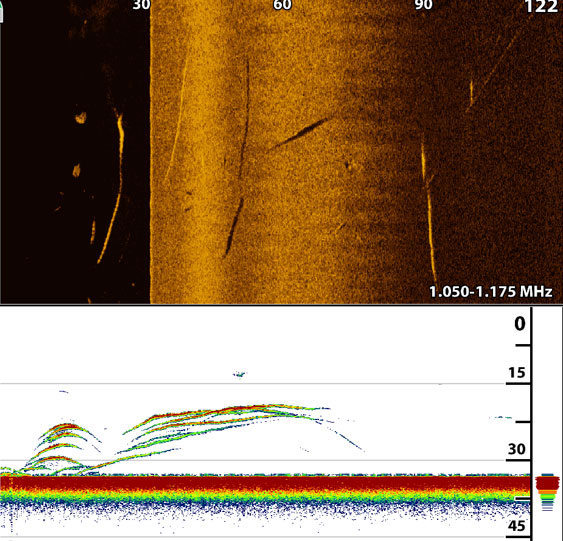
Step number one in interpreting these shadows is simply making sure that you’ll see them. Adjusting the sensitivity and contrast in tandem will have a big effect on what you see on-screen, and this is true not just for the objects themselves, but also for their shadows. Tone down the contrast too much and those shadows can become invisible. Crank the sensitivity too far and they may blend into the background. There is no “right” setting because it will change with the conditions and the depth, so the critical thing here is simply to remember to keep adjusting and re-adjusting.
Sidescan Shadow Boxing
So how do you interpret those shadows to turn what you’re seeing into useful angling intel? If you’re looking at a shadow being cast by structure, the size of the shadow gives you some insight into the height of the object. An item sitting on the bottom that doesn’t cast a shadow is probably very low in profile. A small shadow tells you it’s not a terribly tall item, and a big shadow indicates a more substantial item.
Simple, right? But not so fast, because there’s a catch: the shallower the water is the longer a shadow an item will cast. The variable here is the angle at which the beam shooting out from your transducer interacts with the item in question. Consider a three-foot-tall pile of riprap lying on the bottom in five feet of water. This will cast a huge shadow. But that same pile of rocks in 50’ of water will cast a much smaller shadow, because your boat’s elevation is 10 times as great and the beam shot out from the transducer is at a much higher angle to the obstruction. More of the beam goes over it and hits bottom beyond it, rather than being blocked and creating more shadow.
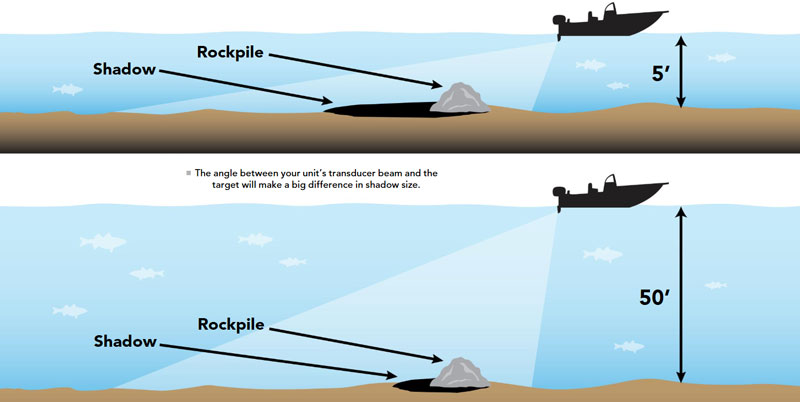
And there’s another catch: the farther an item is from your boat, the longer a shadow it will cast. Let’s say that pile of rocks was 50’ off to the side of the boat and now let’s move it out to 100’. Again, we’ve changed the angle between your transducer and the object, which has the effect of making the shadow longer.
When it comes to fish the dynamic gets even more complex because they’re smaller targets, often suspended off the bottom as opposed to sitting on it. If you see shadows from the fish with little separation from the bottom that indicates they’re deep, and if there’s a lot of separation that indicates the fish are higher in the water column. If you see fish marks with no shadows, they may be sitting right on bottom. But fish that are right up at the surface probably won’t show a shadow either, because the angle between the transducer and the fish is so slight that the shadow is likely beyond the unit’s range. And on top of that the confounding factor of the fish’s distance also comes into play, just as it did with static objects.
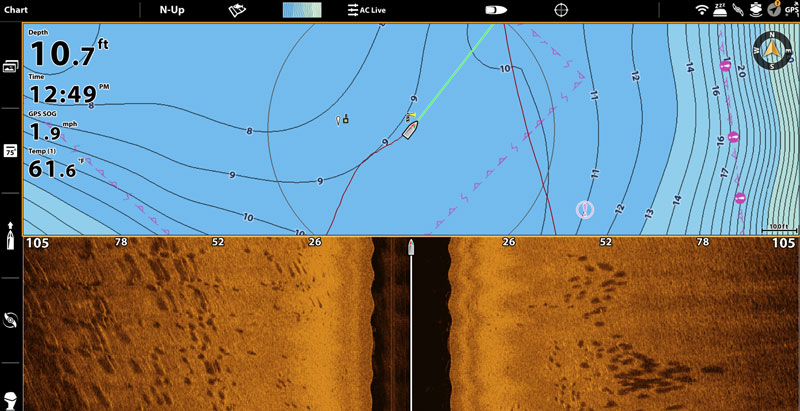
Current conditions and a knowledge of what the fish have been doing lately can help you interpret what you see on the fishfinder screen, too. If there’s a bird show going off and you see marks 25’ off to the side with no shadows, for example, you can be fairly certain those are fish up at the surface as opposed to hugging the bottom.
With time and experience, although it will always be a guess to some degree, you’ll get better and better at guessing where those fish sit in the water column. Spend enough time on the water playing with that side-scan and even us slow learners will eventually learn. Now if you’ll excuse me, there’s some drywall I have to go patch. I have a putty knife somewhere, but I think this screwdriver will do the trick.