When I owned pedal-drive kayaks I often trolled four lines at a time and could employ a number of kayak trolling tactics. The pedal drive kept my hands free and allowed me to keep moving forward while I was fighting a fish. I could continue to make forward headway, allowing the other lines to trail behind the kayak in a mostly parallel manner. In my paddle kayaks, however, I typically troll two or three lines at a time. When a fish hits I must set down the paddle, pick up the rod, and start winding in, and if I had been traveling against the wind or current, the kayak would soon begin turning and moving backwards. This is intimidating for beginners, but with some practice you can learn to deal with those conditions.
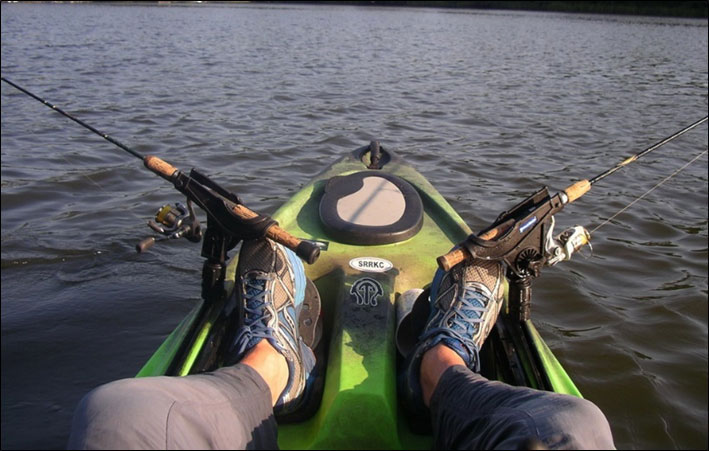
Setting up the kayak - I installed four rod holders on my kayaks, two in front of me and two more behind. They are all in positions where I can reach them easily to rotate them from traveling position to trolling position without straining or leaning out to the side. The two front ones are turned at a 45-degree angle toward the front of the boat and the two rear ones are turned at a 45-degree angle toward the rear.
The other rear rod holder is not pivoted out—it remains in line with the hull and is used to store an extra rod.
Putting out the lines – Paddle to get up to speed, then cast one line out. By the time the lure hits the water place the rod in its holder and paddle a few more strokes to get back up to speed so the lure doesn’t hit bottom. Continue this pattern to get the second and third rods out.
I’m often asked how much line I put out when trolling. I am not terribly precise about this. For the rods in the front rod holders, I choose whichever are the lightest of the lures I am trolling that day and make a “half-cast” out to the side or behind me before setting the rod in its holder. The rod that goes in the rear rod holder generally has the heaviest of the lures in the spread and I toss that out with a full cast. By using different weights on the lures and different lengths of line, the lures are separated and less likely to tangle when I make a turn.
Moving along and trolling – Much of my trolling is done in water of three to six feet. Even when using light lures, I need to worry about the lures dragging on the bottom and picking up debris. So, I need to keep moving most of the time, stopping only to reel in a fish or check my lures.
If stopping is necessary, reel in all the lines to make sure the lures didn’t get fouled while dragging on the bottom. Also keep a watch on the rod tips and the degree of bend in the rods. You may see a rod tip bounce, then return to its normal position. That may indicate that a bluefish has nipped off the tail of a jig or the lure bumped into a submerged branch. You may also notice that the bend in the rod seems greater than when you started. That often indicates that the lure has snagged a piece of vegetation.
Catching fish – When it’s clear a fish is on the line, lay the paddle across your lap, remove the rod from the holder, and give a tug to make sure the hook is set. Then you can begin winding in the fish. You will lose forward momentum as soon as you stop paddling and the kayak may twist sideways or drift backwards. If necessary with larger fish, hold onto the rod with one hand and use the paddle in the other hand to make small adjustments to the kayak’s angle and position. Still, some tangling of lines after hooking a fish is inevitable. When coaching inexperienced kayak trollers, I suggest that they start by trolling just one or two lines to reduce tangles. Once they grow comfortable with the motions, they may add a third rod.
-Excerpted from “The Way I Like to Fish, A Kayak Angler’s Guide to Shallow Water, Light Tackle Fishing” by John Veil. You can find John’s books at amazon.com or email him at [email protected].