We’ve all heard an awful lot about catfish in Chesapeake country the past few years, but even after all the bashing on blues and fixating on flatheads, we’re returning to the topic once more. Why? Because if you’re sick and tired of winter weather keeping you trapped indoors, one of the best ways to get outside and enjoy a hot bite is to target winter catfish. Oh, and by the way, those blue cats are a great eating fish, you can take home a cooler full, and when you catch them you’re doing native species a solid at the very same time.

As a general rule of thumb these whiskered critters will continue biting strong until and unless water temperatures drop into the 30s. At that point the action can slow quite a bit, but even then it doesn’t cease and with water temperatures in the mid-30s you can hope to put several fish in the cooler (with no ice necessary). There’s plenty of public access in areas where you can cast for them from land, piers, and bulkheads. And rigs and baits are about as simple as it gets.
Where to Find Winter Catfish
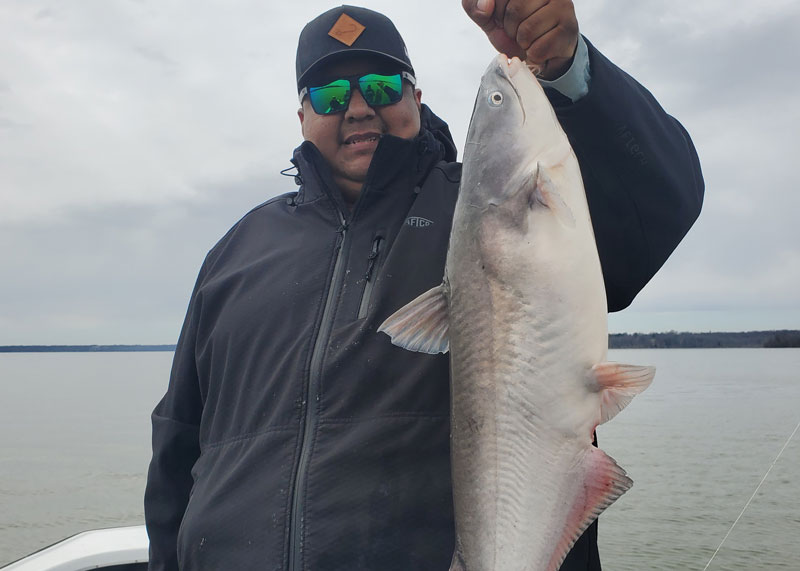
As a general rule of thumb you’ll need to reach deep water to enjoy success at this time of the year. “Deep” is, of course, a relative term. At times it will mean right in the channel. But in many tributary areas there might be a 30’ or 40’ deep channel flanked by four- or five-foot-deep flats—and if you find an area where a 10’ or 12’ deep feeder or trough cuts from the channel into the flats, that much depth can be enough to attract both solid numbers and large specimens. The biggest blue cat I saw in 2025 (a 44-pounder caught in February) came from a 15’ depression in the Potomac River which was surrounded by 10’ of water, but ran all the way out to the channel edge.

Like all fish blue catfish like structure, so rocks, a sunken tree, or any other anomaly on the bottom will help keep fish in the area. Flatheads are known for being partial to rocky terrain and sticking close to boulders. Also like all fish, catfish do change their preferences from day to day. When fishing from a boat this means doing a bit of prospecting and looking for marks to figure out if the fish are hanging along the channel edge, how deep they are, or if they’ve moved elsewhere. When fishing from land this means casting in different directions and to different distances until you figure out what works. Either way, as with just about all forms of fishing it’s smart to keep moving or changing what you’re doing if the bites aren’t coming.
How to Catch Catfish in the Cold
Rigging for cold weather catfish is mercifully simple: try a mix of fishfinder and Santee Cooper rigs (like a fishfinder but with a float just above the hook to keep the bait just off bottom) with an 8/0 or thereabouts circle hook and enough weight to keep the rig planted firmly on bottom in whatever current there may be where you’re fishing. Using 30-pound leaders would be considered light by most catfish sharpies, and at the other end of the spectrum 80-pound leaders would be on the heavy side.
You can use just about any rod and reel for catfish fishing, but coming properly armed will help you maximize the catch. Considering that some of the catfish in our area can reach rather epic proportions, using 40- to 50-pound gear is not out of line. Some anglers prefer conventional and others favor spinning gear, and both work just fine. When using spinning gear, however, having a baitrunner feature so you can minimize tension on the initial take will give you an edge. Rods should have plenty of backbone—capable of dragging 40- and 50-pound fish through a current—but have a tip sensitive enough to spot sometimes-subtle bites. Many anglers who catfish through the summer months will also want to opt for rods with a bright UV finish for night fishing. We’ve used the Okuma Cat Slayer Custom CSC-S-761ML spinning rods paired with Cat Slayer Custom reels and found the rigs ideal for the job.
The Best Catfish Bait for Winter Fishing
As for bait, chunks of mud shad or bunker are standard, at times cut white perch will beat either, and frozen works but fresh just about always beats it. Some anglers favor chicken livers or chicken breast, especially during the winter months when finding fresh baitfish can be a challenge. And many catfish sharpies swear by soaking chicken breast strips in cherry Kool-Aid. A new option we’re crossing our fingers for is Fishbites Catfish Baits, which are mess-free marshmallow-like nuggets. We know it works for summer and fall fishing and found Shad and Shrimp flavors the best, but we haven’t yet tried it in uber-cold weather so the jury’s still out as to winter fishing with it. Naturally, you can bet we’ll be giving it a shot in the coming days and weeks. Because now that winter has set in and the angling options have been trimmed down, targeting catfish will be a great way to cure that cold weather cabin fever. If you don’t want to wait for warmer weather before kicking the season off, chasing catfish is a great way to get it started - bundle up and prepare for battle.