If you’ve never tried crabbing it might seem a bit mysterious. What’s the best bait? How do you pick a productive spot? Wait a sec—you catch these crafty critters without any hooks???
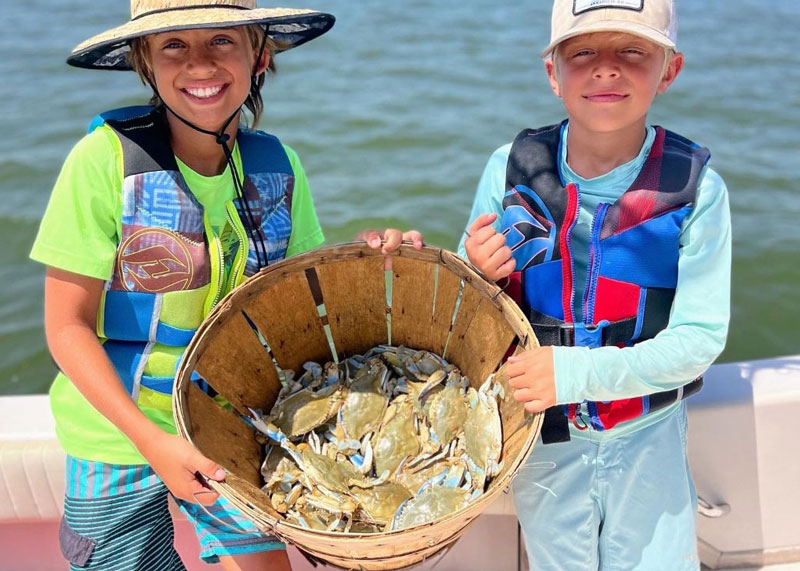
In truth, picking up crabbing is a piece of cake even if you’ve never been exposed to it before. At least, picking up the basics is. Don’t think you’ll fill the bushel basket to the top at the very start, but hoping to catch a dozen or two crabs is a realistic goal right from the very beginning. We’ll look at how by starting with the easiest method and working our way up to the most complex.
Hand Lining for Crabs (Chicken Necking)
Hand lining is the slowest but simplest method of crabbing, can work from a pier or an anchored boat, and as you can tell from the header for this section bait choice is easy for first-timers going hand lining: get yourself a pack or two of chicken necks. Just about everyone does, which is why it’s commonly called chicken necking. Fish chunks or heads work great, too, but easy availability, a strong resistance to being picked apart in short order, and the crab’s love for ‘em make chicken necks an easy top choice. The only other items you’ll need are a ball of string, some weights, and a crabbing net.
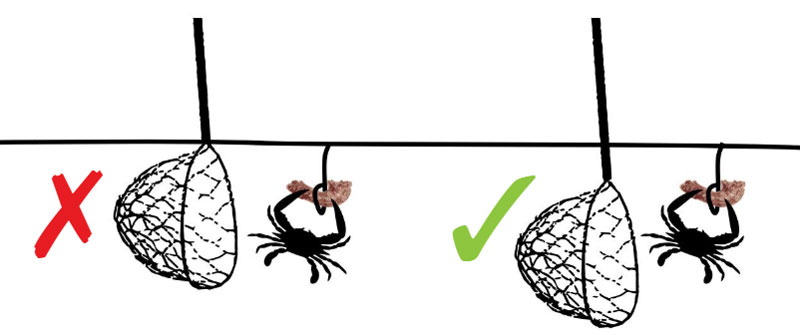
Cut the string into sections long enough to hit bottom plus a few feet, tie weights on each one (a quarter ounce is usually plenty), add a bait to each line, and lower away. Let the lines sit with slack, and when a crab grabs the neck it will try to move off and you’ll see the line come tight. Pull it in inch by inch, and when the crab comes close enough to the surface, slide the net under it from behind and scoop up. It’s usually best to try sneaking the net under the crab but be prepared to scoop fast if it spots the net coming and drops off the bait. Always come in from behind or the crab will see the net coming from a mile away and dart off.
Crabbing with Pull Traps
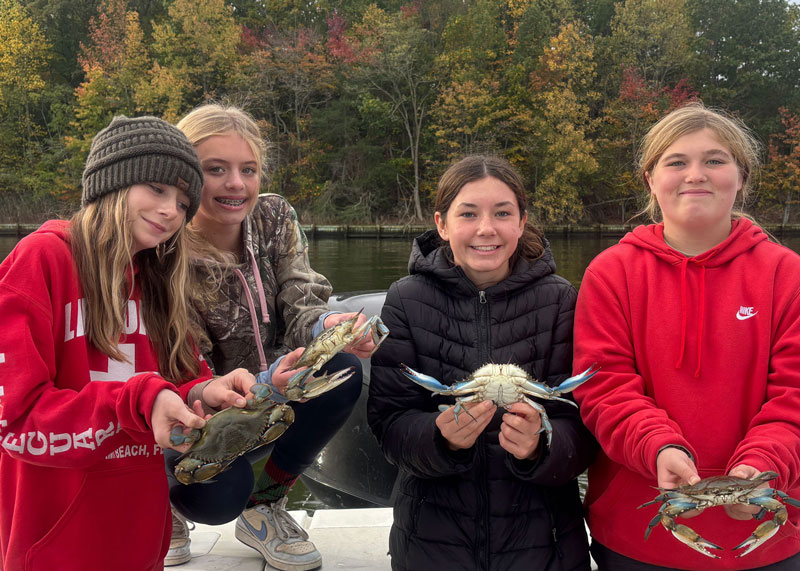
The second easiest way to catch a mess of crabs is by using pull traps, and with an equal number of traps versus handlines you’ll often catch twice as many crabs simply because you won’t have them jump off the bait or miss any scoops. Stack-able traps with no top are best if you’ll be using more than eight or 10 at a time, simply as a matter of storage and transport. You can use these, which are also called “snap-traps,” from a pier, off of a boat, or by tying buoys on the end of the lines and setting out a bunch, then driving your boat around to check them one by one.
Again, chicken necks are a great bait. Some traps have a small bait cage in the bottom, and in this case, cut fish works great since you don’t have to tie it on a line then worry about a crab picking the bait free. Simply bait up your traps then lower them to the bottom, where the sides of the trap will fall open. When you want to check a trap lift the line quickly to snap the sides up then haul it in without allowing slack in the line.
You won’t know when a crab is inside so you’ll need to pull each trap every 10 or 15 minutes, or quicker when the action is fast. When there’s a keeper crab inside invert the trap and shake it over your container or drop the trap to the pier or deck—and be ready to pounce so it doesn’t get away when the sides fall open.
Note that traps are a top pick especially when you aren’t sure where the crabs are, you’re on a boat, and you need to do some prospecting. It’s extremely fast and easy to move them around and try different spots.
Trot-Lining for Crabs
Trot-lining is generally the best way to catch the most crabs in the shortest amount of time. That said, it’s also the most complex way of crabbing. It requires a boat or kayak, it requires the biggest investment in gear, and it’s the one form of crabbing where we’d say you really need to go with a friend and see how it’s done first-hand before giving it a shot on your own.
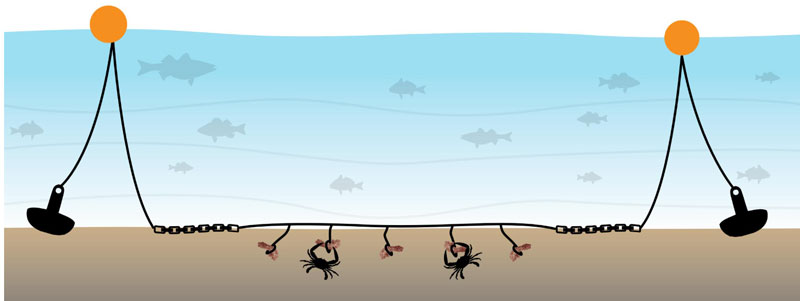
Trot lines can be anywhere from 500’ or 600’ to over 1000’ long. Most have a bait every four to six feet, sometimes hanging from a “snood,” which is a short bungee dropper line with a loop you can cinch down tight on the bait. Often that bait will be chicken necks, which fit into the snoods perfectly, though crabbers sometimes use baits like salted eels, bull lips, or mesh bags filled with smashed razor clam. A length of chain is added to either end to weight the line down.
For marking and securing the trot line you’ll have a float tied off to 20’ or so of line attached to the other end of the chain. A separate line runs from the float to your anchor. Mushroom anchors work well but you’ll also see people use gym weights or other forms of anchors that can be dragged. You don’t want to use Danforth or other boat anchors, because they dig in firmly and you’ll likely need to pull and drop the anchor from time to time to stretch the line tight. Other times, you may want to pull one anchor and drag the line into a different position, so you want the anchors to be more or less mobile.
As you bait up the line at home coil it into a bucket or basket, being careful not to make tangles so it deploys smoothly. Get on a steady course, drop the first anchor and float, then the line with the chain attached to the trot line. Pay it out as you motor along, grasping it to pull the line tight for a second or two every 100 yards or so. When you reach the end send over the second float, pull the line tight, then send over the second anchor.
Once the line is set, you can motor back to the beginning of the line, use a boathook or the head of your net to grab the line under the float, and drop it into your crabbing stick.
Crabbing stick? Yep, you’ll need one of these, too. The crabbing stick is the U-shaped arm which the trot line will run through as you idle alongside of it. You can purchase crabbing sticks that drop into a rod holder, or you can build your own. Most crabbers use PVC pipe to make a stick, and give it an arm long enough to secure it to a bench seat, console, or other part of the boat. Every boat is different, so you’ll have to figure out the best rig for your situation.
Once you’ve picked up the line and dropped it into the stick, idle along at minimum speed while someone holds the net, ready to scoop when they spot a crab coming up on a bait. Some people like to scoop as a crab approaches, while others hold the net in the water at the appropriate depth and let the forward motion of the boat do most of the scooping.
So: are you intrigued by the idea of catching those crustaceans yourself, rather than procuring them with a purchase? Don’t hesitate to try scooping and snap-trapping instead of spending your scratch this summer, because even a first-timer is likely to go home with some Jimmies. And even if you only manage to scratch out a half-dozen crabs, we’re betting you’ll have so much fun catching ‘em that you’ll soon come back for more.
Crabbing Tips
- When trot lining, accidents can and will happen. The line can get snagged on something, and you have to be careful not to steer the boat over the line—or the something it snags will be your prop. For this reason, whenever there’s a breeze it’s best to avoid running with the line on the downwind side of the boat.
- When it comes to crabbing nets those with wire mesh are vastly superior to those with knotted nylon, because the crabs and their claws will get tangled and stuck in the nylon mesh and it can take several minutes to get them out. Either wood or aluminum poles are fine, but as a general rule of thumb lighter is better since it allows for faster scooping. Peek at the hoop-to-handle connection before choosing a net, too. Some are more rugged than others and the ones with either end of the wire hoop going into an aluminum sleeve that’s crimped in the middle tend to get wobbly and give out faster than many others.
- Crabs need to be kept chilled during the heat of summer or they’ll die off, and you want to steam those crabs up live. They’ll also die if you place them directly on ice, or in a bucket of water without aeration. When kept in a bushel basked keep them shaded and douse them with Bay water every half-hour or so. If you’ll keep them chilled in a cooler it’s best to pre-freeze a few water bottles or jugs rather than using ice.