Red Alert—As of August first striped bass season on the entire Chesapeake Bay from Perry Point to Wise Point will be completely closed. Chances are you already knew that, and it’s also quite probable that you already have a long list of other species in mind to tackle this month. There’s just one problem: no matter where in Chesapeake Country you may wet a line, there’s always a chance that you’ll catch some rockfish purely by accident. And if you give two hoots about those fish you’ll make darn sure you don’t put a treble hook into the water anywhere it’s likely to get smacked by a striper this August.
If you’ve delayed swapping out those trebles for single hooks, we don’t blame you. It’s a hassle, and if you choose the wrong hooks you may alter the way a lure swims and/or downgrade your hookup rate. But now—right now—is the time to spring into action and make it happen. And we’re going to try to help make it as painless as possible.
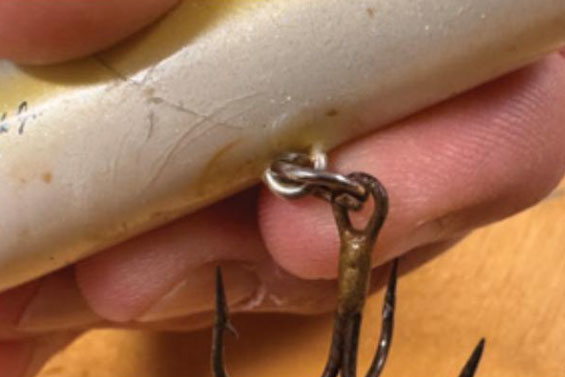
Step 1: Get a pair of mini split ring pliers. We’re specifying “mini” because the average 5” to 7” split ring pliers on the market are too big for the average rings on four-to six-inch plugs and spoons. We’ve found the Texas Tackle small size (4.5” with very thin jaws) to be the easiest to use. It can take 10 minutes to swap out a pair of hooks using the wrong pliers versus one minute using these. Then hold the treble hook and spin the split ring until you ID the spot where one of the side-by-side wires ends. Holding the ring, let the hook slide below this point and hang there.
Step 2: Insert the smooth side of the plier jaws through the split ring and clamp down with the pliers’ tooth hitting in between the two wires. As you apply pressure it will split them.
Step 3: Maintaining pressure to keep the wires separated, slide the hook up until it’s in between the two wires. Then release pressure on the pliers and slide them slightly further through the split ring so the tooth no longer grabs between the wires (the hook will keep them separated at this point). Use them to grab the ring and rotate it slightly as you hold the hook, so the wire slides through its eye. Grab and rotate several times until the hook slides off the other end of the wire.
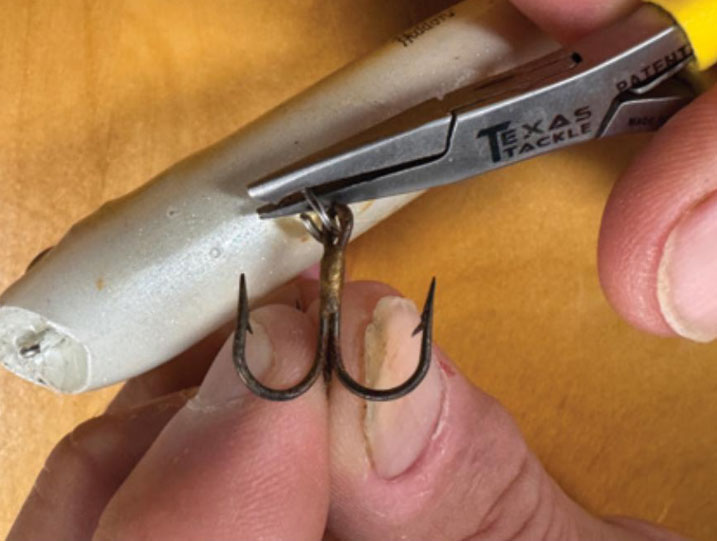
Step 4: Using the split ring pliers re-open the split ring, and slide the eye of the single hook over the end of the wire.
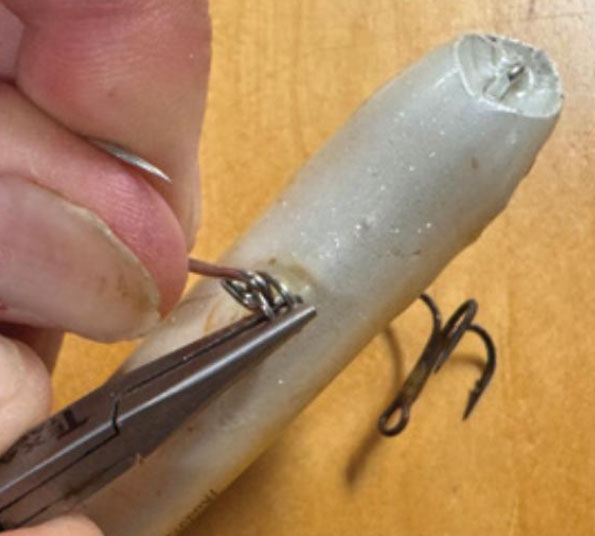
Step 6: Use the split ring pliers to again grab and rotate the ring until the wire end pops through the hook and it’s swinging on the split ring. Most anglers prefer the forward hook on a lure to face gap-forward and the aft hook to face gap-aft. We’ve tried it both ways and don’t think it matters at all for the hook on the back of the lure, but the point of the front hook does sit up against the lure’s body if the gap doesn’t face forward.
Congrats—your nasty, pokey, fish-jabbing, thumb-wrecking treble hooks have now been replaced with inline singles. Cancel tomorrow’s plans and go fishing, instead!
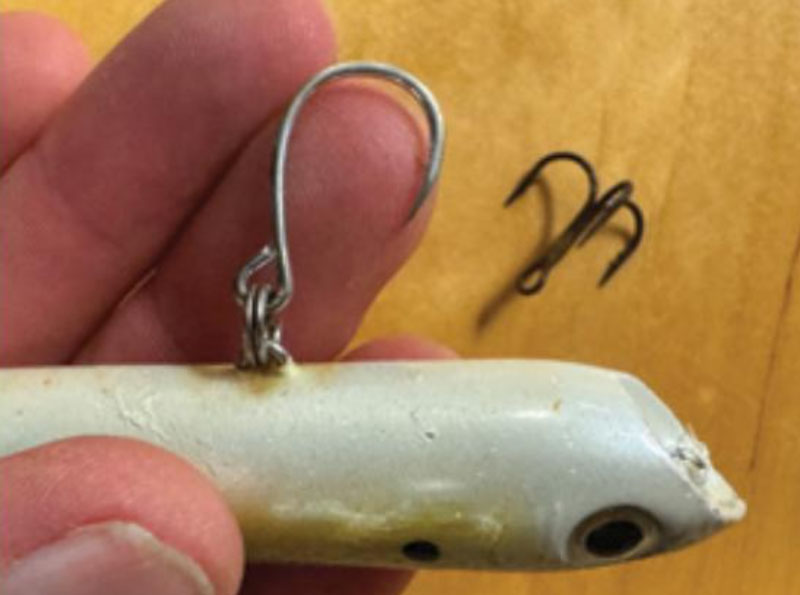
Choosing the Right Replacement Hooks
You’ll need inline singles, which have the eye in line with the hook shank. As a general rule of thumb to avoid interfering with the lure’s designed action it’s best to choose hooks that are two sizes up from the treble’s size. So, if your lure has 1/0 trebles, get 3/0 singles. Treble hook size isn’t always printed on a lure’s packaging, but as long as you know the lure brand, model, and size, finding it out is a quick Google search away.
So: just how many strikes will you miss when switching from trebles to singles? Not many, if any. I started switching them years ago and if it makes any difference it’s certainly not dramatic enough to notice.