Just ask yourself: the last time you had a kayak fishing disaster, was it similar to something you once heard a buddy talking about? We thought so. Many of us anglers like to learn the hard way. Well, maybe we don’t like it, but often that’s what ends up happening. As a result, we expect that someone may read this Paddler’s Edge, go out, and do one (or more) of these things anyway. No big deal—if you’re out there trying, hitting a road bump here and there is guaranteed. But don’t say we didn’t warn you.
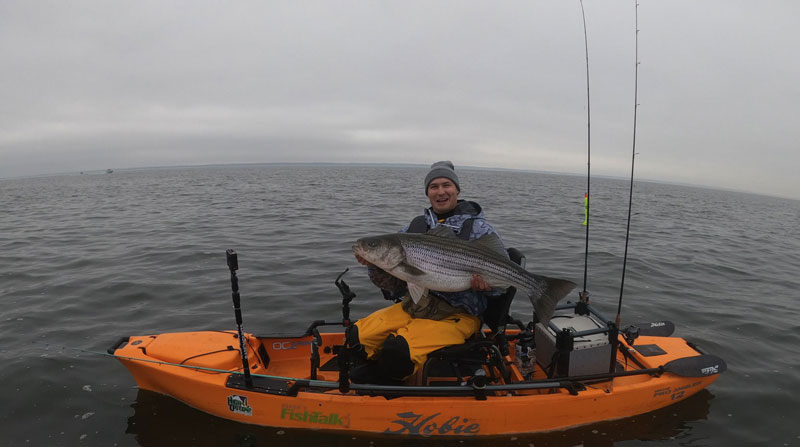
- Before approaching a shoreline with overhanging brush to retrieve a tangled lure out of a tree branch, first take any other rods out of vertical holders and lay them flat. Otherwise there’s an excellent chance they’ll grab a different branch and you’ll be dealing with two messes instead of one.
- When you’re new to kayak fishing don’t use expensive rods and reels, and when you’re an intermediate kayak angler don’t use super-expensive ones. You’ll drop some, some will get dunked in saltwater, and you might even flip the yak a time or two. Wait until you’re thoroughly experienced before dropping big bucks on something that might get dropped.
- Put on the dang PFD. Put on the dang suntan lotion. And if you’re fishing the backwaters of the Eastern Shore during summertime, put on the dang bug repellent. (But do so carefully, because the active ingredient DEET is a proven fish repellent, too).
- Always check the weather report and take note of not only the wind speed, but also direction. In anything over 10 or 12 mph you may want to consider launching somewhere that allows you to fish leeward shorelines. And if the breeze is expected to pick up or change direction later in the day you’ll want to know, or you may find yourself battling a stiff breeze as you try to go home. Which brings us to…
- Always, always, always check the tides if you’ll be fishing in an area subject to strong currents. Traveling for a couple of miles can seem like a piece of cake when you’re going down-current, but going up-current will be a very different story. Consider this: if you normally pedal at a four-mph pace and you face a two-knot current, you’ll essentially have to “travel” twice the distance to get back to the launch point.
- Keep the bow more or less pointed at your target whenever possible. Anytime you shift weight side to side it has a much more dramatic effect on the boat’s stability versus shifting weight fore and aft. When you’re fishing out to the side merely attempting a hook-set can be enough to roll the boat if it’s done awkwardly while the adrenaline is pumping.
- When fishing a rocky river from a pedal kayak with a prop drive and you’re going to go through shallows, get out and wade. You may think you see a path that’s deep enough, but if you’re wrong and you snap off a blade…
- Don’t store your kayak sitting in the sun with no cover. The vast majority of fishing kayaks are rotomolded polyethylene, and while most of today’s plastic yaks are UV “resistant” they definitely aren’t UV “proof.” Plus, hour upon hour of direct sunlight will also degrade the fittings, bungees, and other pieces-parts. Unless you keep it indoors, after buying a kayak your very next purchase should be a properly fitted cover.
If you take heed to all these warnings, might you still have a kayak fishing disaster of your own? Probably—the only way to ensure that nothing goes wrong is to sit at home on your couch. And while that might be a lot less risky, it’s also one heck of a lot less fun.