Water, water, everywhere… and a bunch of it that fish can’t live in. Or crabs, or oysters, or anything else, because it’s anoxic. As in, there’s no oxygen. Just imagine if you were walking down the street in Norfolk or Naptown and suddenly entered a pocket of air where there was no oxygen. You’d sputter, gasp, and probably try to run. Maybe you’d make it back to breathable air in time to survive, and maybe not. That’s exactly what’s happening to creatures living in the Bay every summer.
We’ve all heard about the “dead zones” that form in water 20’ and deeper as the water heats up (the warmer the water is the less oxygen it can hold) and as anglers, during the summer many of us look for areas where the deeper waters aren’t dead zones to find fish. What I hadn’t realized until this summer is just how rapidly localized dead zones can form, move, disappear, then form again.
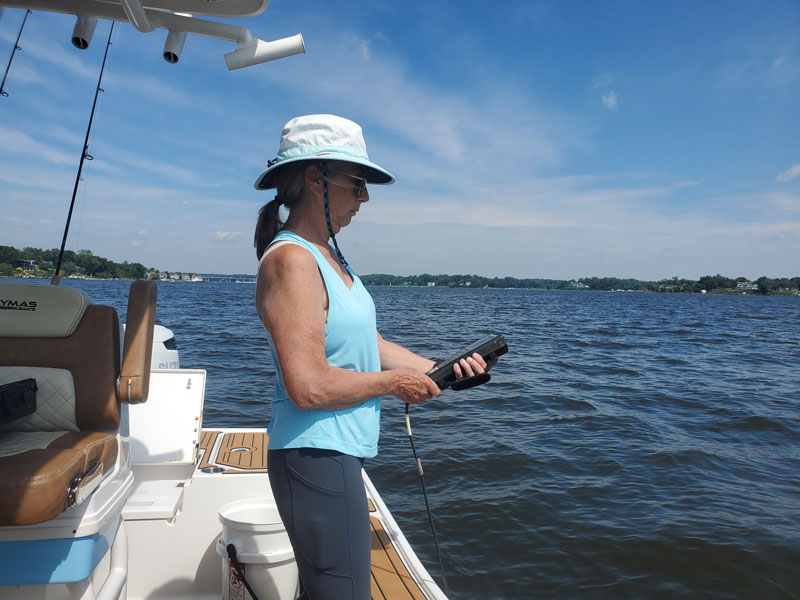
This spring and summer I volunteered to do some water quality monitoring in the South River for the Chesapeake Bay Foundation. Three years into an oyster restoration project the oysters seemed to be doing better than expected, a rare potential bright spot in this very challenged middle Bay Western Shore river. They were hoping to get steady weekly data on water quality at three different sites of varying depths, all shallower than 20’, in the river.
Early on the oxygen levels were relatively good, ranging from three to six mg/l. Then one day in late May they plummeted, reaching as low as 0.53 mg/l. Water below two mg/l is considered hypoxic (very low oxygen); oysters can survive for about two weeks in it, while fish like striped bass prefer more like five mg/l and can only survive a matter of hours in hypoxic conditions. I was thoroughly depressed. Were the oysters dying even as I stood there on the deck of my boat staring at numbers on the meter? Maybe not—in the next few weeks, I watched as the oxygen levels bounced back up and down above and then back below hypoxic levels at the different sites. I saw 3.49 in one spot, and 0.75 less than half a mile away in another. The next week the oxygen level at the “good” site had gone hypoxic, while the one that had been the “bad” site seven days earlier climbed back into survivable oyster territory.
Why was the water quality jumping around so much? We had only one major rainfall through this period (rain and major storms can significantly affect dissolved oxygen levels), and temperatures had increased steadily. Was I working the meter improperly somehow? Unsure of myself, I checked the (much deeper) fixed South River sampling site on Eyes on the Bay, and it showed a similar plunge in dissolved oxygen—but without the life-saving swings upwards.
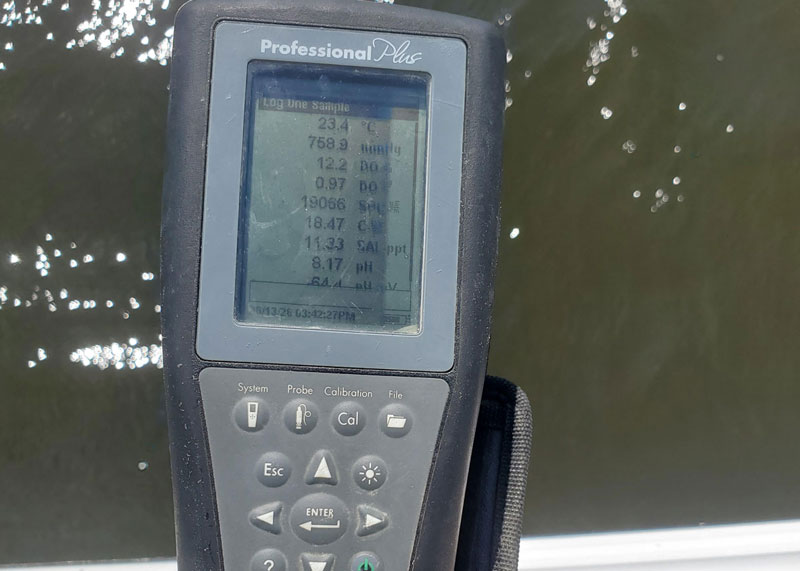
Now, for the angling tie-in: I’m far from a scientist, but I do try to apply a scientifical-ish approach to my fishing whenever possible. So, on these visits to the sampling sites I came armed with bottom rigs and bloodworms. I dropped ‘em down while I sat there waiting for the water quality meter to do its thing. And I did find a direct correlation between oxygen content and the presence of fish: when oxygen levels were around 2.5 mg/l or higher the bite was good. Mostly spot and croaker, but also a few small weakfish—and then later, hordes of small weakfish plus silver perch. When the meter read lower than that the bites were few and far between. And when it said oxygen levels were below 1.0 mg/l I didn’t get one single nibble. Ever.
There are two morals to this story. First, for we anglers: if you’re fishing over oyster bottom in the summer months and not getting bites, leave the area because you might be fishing in a patch of hypoxic water. You don’t necessarily have to move very far, though, because the pockets of dead water can shift and move, and at least in depths of less than 20’, may be localized and temporary. Second, for all of us living in Bay country: despite the raft of problems the Bay faces there is hope for every inch of the Chesapeake. If oysters can be restored in a densely paved and populated watershed like the South River, they can be restored anywhere.