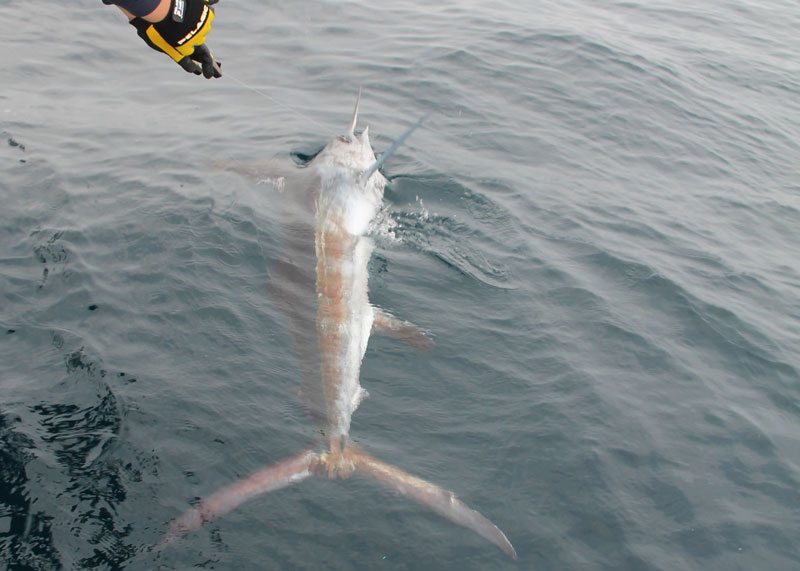
How in the heck did that stick get tangled up in the spreader bar? Wait… WAIT—that’s no stick, it’s a billfish swiping with its bill. Quick! Grab the pitch bait! Unless you don’t have a pitch bait at the ready, in which case you’ll likely watch as that stick disappears. And that, anglers, is what we call a missed opportunity. Whenever you’re trolling offshore you should always, always, always have a pitch bait at the ready.
Pitch Bait Basics
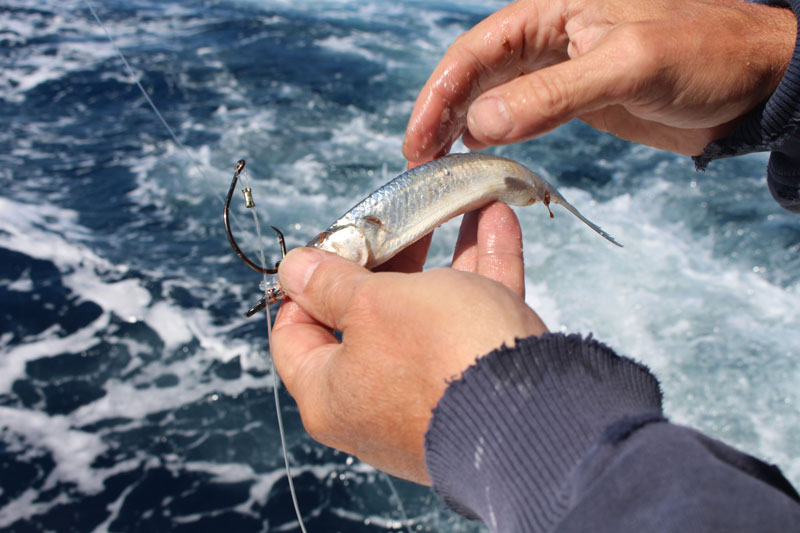
A pitch bait is simply a rigged ballyhoo that you keep ready for deployment at all times. Then, when a marlin gets spotted batting at or shadowing a lure, teaser, or dredge, you can send that pitch bait back to it and offer some additional temptation.
Most anglers will stick with a naked medium or small ballyhoo for this purpose, simply because most of the bills we spot off our coastline belong to white marlin and they’re partial to relatively small baits. When the bigger blue marlin have been around and you want to be ready for them a large or horse ballyhoo is more appropriate, though many would point out that blue marlin are big enough that they usually don’t hesitate to attack the larger offerings in the spread and will often make their move before you can even get a pitch bait in the water. In truth, few anglers in this neck of the woods prep pitch baits for blues but instead have a horse ballyhoo somewhere in the spread which can be redirected if a big fish shows up.
The pitch bait will generally be rigged on an 80- to 120-pound fluoro leader with an 8/0 circle hook on the end. (When blues are in the bullseye up-sizing to 200- to 250-pound leader and a 10/0 or 12/0 circle hook is in order.) Most of the time the rig will be on a relatively light rod and reel that can be easily wielded and is appropriate for white marlin, like a 20- to 30-pound class high-speed conventional spooled with 30- to 40-pound line. Many anglers prefer mono for this purpose but some favor braid. Pick your poison, but note that mono does help slow the application of pressure when you initially come tight on the fish, which assists in setting a circle hook on a billfish (it works best when you come tight slowly with no abrupt jerks or tugs). Again, blue marlin require up-sizing accordingly.
The bait needs to be prepped and ready to roll at a moment’s notice, so it’s generally rigged on the way out or the moment you get the spread set. Once fishing, it should be stowed in such a manner that it’s ready for instant on-the-fly deployment. That means holding it in the water next to the boat at trolling speed and watching it closely to make sure it swims properly, then putting it on ice or in water. Some anglers like to put the rod in a transom holder and slide the bait in an iced transom rigging box, while others put the rod in a chair or battle-station holder and drop the bait into a five-gallon bucket; how you stow the pitch bait really depends on the layout and nature of your boat and what works best in the cockpit. When putting the bait into a compartment with a fiberglass hatch, consider putting a small rag or piece of line over the lip so the hatch doesn’t damage the leader. Bottom line, you need to be able to grab the rod and get the bait into the water in a mere second or two.
Throwing the Pitch Bait
When a billfish appears and you spring into action, tossing out that pitch is simple. Drop it into the water, point the rod tip directly at the fish (or slightly off to the side if a trolled rig or lure is in the way), and go into freespool with the clicker off. Apply just enough pressure with your thumb to prevent backlash and let the bait slide back to the fish. Some sharpies advise letting it sink past the fish, because often the marlin will mistake it for a bait that’s just been stunned by its bill and attack. Some others feel it’s best to stop the bait a few feet in front of the fish, and swim it there. Truth be told every fish and every presentation is a bit different and it’s impossible to say which will work best at any given time. But if you try one and the fish doesn’t take the bait, try the other.
If a marlin eyeballs the swimming bait but doesn’t attack, don’t just let it sit there and hope the fish will change its mind—give it some extra action. Try a couple of quick jigs, and if there’s no response take a few cranks on the reel. Fool the fish into thinking the ballyhoo is trying to escape. If the billfish is riddled with indecision and sticks around but doesn’t attack for more than eight or 10 seconds, crank the pitch bait all the way back and start over.
Okay: you say you’re ready to swing for the fences this fall and target marlin at the canyons? Don’t neglect to rig up a pitch bait, and you’ll be ready to react when opportunity knocks.