Living in the Mid-Atlantic zone we enjoy fishing in freshwater, we enjoy fishing in saltwater, and at many times in many places we can target the very same species. Pickerel? Yep, they’re in water both salty and sweet. Stripers? They can be found in plenty of landlocked situations. Yellow perch? You betcha. But there’s a catch: if you fish using the same lures and tactics in both bays and lakes, in one venue or the other you’re likely to fall short. This is particularly true for yellow perch, which can act so differently between freshwater and the salty stuff that targeting them requires an entirely different mindset.
Top Yellow Perch Baits in Freshwater
Baits are the first topic to address. Yellow perch will eat minnow in both types of waterways, but different minnow. In reservoirs and lakes they’ll readily take shiners. But don’t grab a bunch of bull minnow out of the trap and figure on using them in freshwater. You’ll still get bites sometimes, but not nearly as many as if you offer up the shiners that they’re accustomed to dining on.
The night crawlers that rarely work well in the Bay and tributaries, meanwhile, can be quite productive in freshwater. And there’s one bait that rarely occurs to salt-oriented anglers for freshwater yellow perch which is an absolute killer: crayfish tails. Rip one off, thread it onto a hook from the top to the tailfins, and pop it out through the underside. The crayfish tail readily conforms to the shape of the hook and when you put it in the vicinity of a yellow perch living in freshwater, it can rarely resist.
Top Yellow Perch Lures in Freshwater
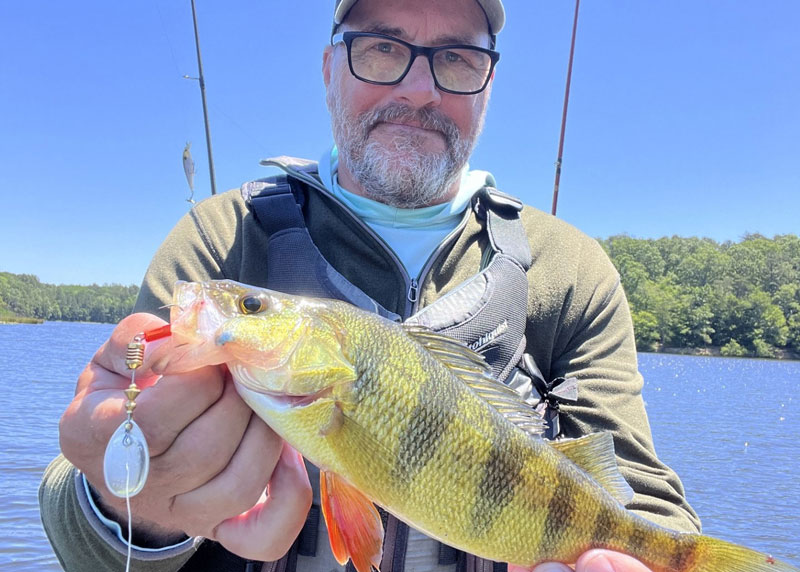
Lures that are effective in saltwater, on the other hand, often do carry over quite well. Spinners in particular, as well as tube jigs and small crankbaits. But there’s a catch. These only work well when you can present them at the proper depth. And in reservoirs and large lakes that depth may be very different than where you’re used to finding yellow perch—especially during the summer months. Which leads us to…
Finding Freshwater Yellow Perch
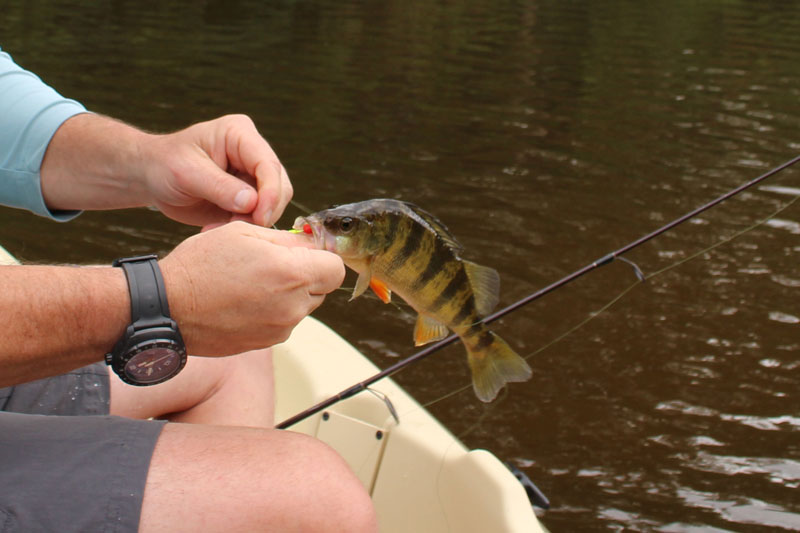
Finding the fish in freshwater venues is quite different from hitting the spring runs in tributaries. During the spring and fall expect the perch to be hanging out in depths similar to crappie and bass. They’ll be looking for the same types of spots, too, like weedbeds or underwater points with cover and bait. But when the heat of summer sets in the yellows are a bit less enthusiastic about sky high temperatures than other species, and they often be the first to retreat to deeper waters.
Depending on the specific lake and other environmental variables, they’ll often be found 20-plus feet down. In this scenario channels in relatively shallow lakes, and/or rocky ledges and trees laying on bottom in deeper lakes, are top spots to prospect. That said, you’ll have a much easier time nailing down productive depths if you can ID a thermocline. Then, look for areas where a drop-off or structure intersects with it and start hunting for the fish. In this scenario finding the fish can be tough but getting bites can be even tougher. During the summer months you’re more likely to find small pods than large schools, and like many species they don’t feed particularly hard at this time of year. When you can locate them on the fishfinder dropping down bait on a top-and-bottom or drop-shot rig is a go-to method, and vertically jigging with tubes, blade-baits, or small jigging spoons is another good option.
TIP: When the fish are excruciatingly scattered, which you will see sometimes in large lakes and reservoirs, locate an area where the thermocline hits a drop-off and try slow-trolling along at the depth of the thermocline. This can be particularly effective with a drop-shot rig and shiners.
Finding Eastern Shore Millpond Yellow Perch
Yellow perch can be found in most of the Eastern Shore millponds, but these are unique waterways and the yellows can be stunningly difficult to locate. Where you find one, however, you often find a big cluster. The best way to focus on them is to stay on the move while casting ultralight gear with a good search-bait, like a small crankbait, tube jig (they love 2.5” red/whites), or underspin. You can work all the way around the shoreline of most of the millponds in an afternoon and with a little luck, if you cast-move-cast continually you’ll figure out where they’re hanging before running out of pond.
Catching Freshwater Yellow Perch
Catching freshwater yellow perch is really no different from doing so in saltwater, however, there’s one final tidbit we want to point out: Forget about slow retrieves and letting baits sit in place. In these venues you’ll find the perch far more aggressive and they enjoy attacking lures pulled at a fast-moving, erratic pace. The difference here isn’t so much the environment as it is the water temps. Many Bay dwellers are accustomed to fishing for perch when the run’s going off and water temps are in the low 50s at best. When you’re fishing in 70- or 80-degree water the speed of everything has kicked up a notch—and that includes the yellow perch.