There are few moments in fishing more frustrating than marking a massive school that refuses to bite. Many of us have been presented at one time or another with a lit-up fish finder that results not in double hookups but rather in bewilderment as to why a striper wouldn’t bite a jig bounced practically off of his nose. Or perhaps, after a week of throwing a white paddletail that gets smoked cast after cast, wind and rain have tinted the water with a brownish-green stain; now that lure seems obsolete, despite casting in areas where you know fish reside.
These scenarios: A) When a school of fish won’t eat and B) When fish are feeding but you’re stuck with heavily stained water, are prime for presenting noisy lures.
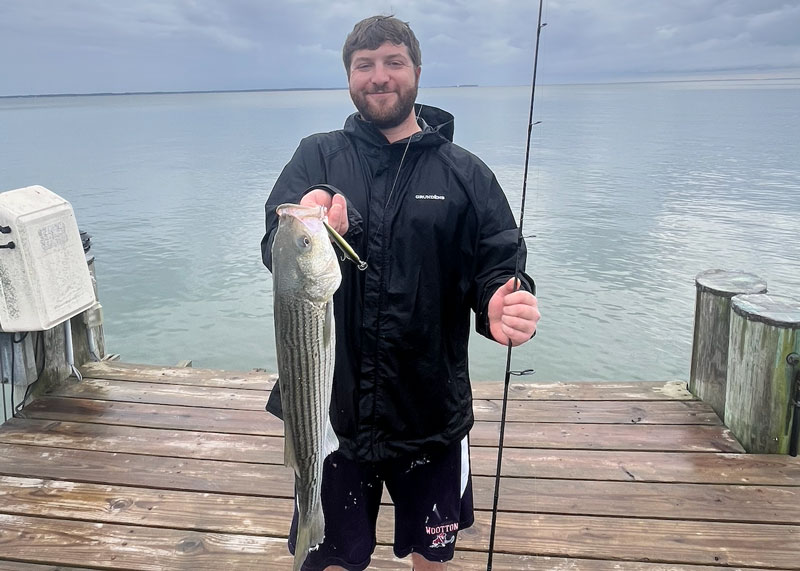
Fish don’t have hands. So, when something irritates them, triggers their predatory instinct, or piques their interest for one reason or another, they grab it with their mouth. Yes, oftentimes in these situations a striper is biting your lure for reasons other than being hungry. We call these “reaction strikes.” And to trigger them, you must use lures that appeal to one or all of the above.
Striped bass, like many other predatory fish species, are equipped with a lateral line stretching from the gill plate to the tail. This anatomical feature allows rockfish to detect vibrations in the water and make sense of their surroundings. To pique a striper’s interest in your lure during muddy water conditions or when their jaws are locked up, choosing lures with loud rattles is a gamechanger. My tacklebox is always stocked full of lipless crankbaits, jerkbaits, twitchbaits, and paddletails, all equipped with noisy features. (If you’re in the tackle shop and aren’t sure which baits rattle, just shake the box and you’ll know pretty quick!).
Enter scenario A) When you know a school of fish is there but they won’t eat. Say we’re working some shallow water riprap with poppers at the crack of dawn. The sidescan is lit up, but not one topwater blowup has occurred. In my experience, a rockfish will smoke a popper before sunrise if he’s hungry. So if he doesn’t want to eat, let’s make him react.
Grab a rattling jerkbait in a natural bunker or mullet-type pattern, and bomb a cast. Crank the reel a couple times to get your lure to depth. Now, give a hard rip with the rod. Quickly reel up the slack and do it again, and again, all the way back to the boat. I sometimes describe this retrieve as fishing a popper, but under the surface. It creates fast, erratic movement that allows its rattles to send vibrations through the water. A rockfish may grab your lure in this instance because he’s annoyed by the incessant rattling, or because this aggressive retrieve made him think an injured baitfish was trying to flee—and that would be too easy a meal to pass up on whether hungry or not. If you’re getting the jerkbait snagged on rocks or if it’s just hitting bottom every time you rip it, switch to a twitchbait and work it the same way.
When we find fish in deeper water that aren’t cooperating, I tend to lean more towards a lipless crankbait (like the classic Rat-L-Trap) or paddletail. There are a few soft plastic brands on the market that offer rattling baits, but most of the time I use a tool like the Zman Rattlesnaker to insert rattles into the ones I like to use. Whether you’ve chosen to tie on a paddletail with a rattle or a lipless crankbait in this situation, it’s wise to select a natural color. With the paddletail, cast out and let the lure hit the bottom. Then swiftly sweep the rod tip up, and let the lure fall back down again.
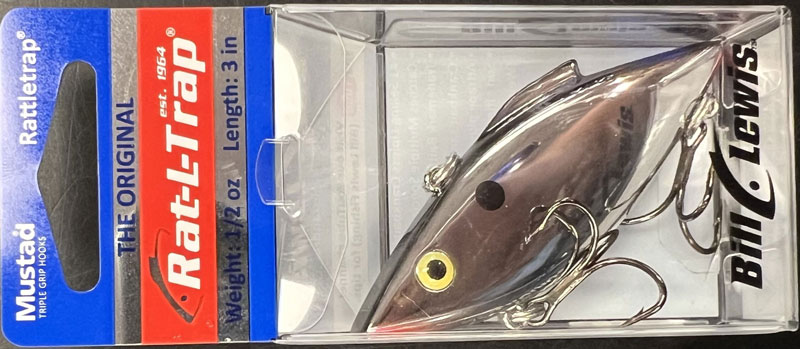
With a lipless crankbait, you’ll feel the vibrations as you lift the rod. Unlike snap jigging where we retrieve with quick flicks of the wrist, this is a more fluid motion. It allows for a period of sustained vibration before lazily trickling back towards the bottom. The idea is to either annoy the fish into grabbing the lure or trick him into thinking it’s prey for easy picking. Either way, it gets his attention.
Now, how about scenario B) When fish are feeding but the water is extremely muddy or stained? Luckily, our retrieve and lure selection stays pretty much the same, with only a few slight alterations. Lure color is the biggest change. Instead of going natural, choose either a very bright color or a very dark color to help the lure stand out in the dirty water. Chartreuse, hot pink, purple, and black are excellent options. I’ll also slow down my retrieval speed to give the fish more time to find my offering in the lower visibility conditions. That may come in the form of a pause before I rip my jerkbait or twitchbait again. It may also entail switching to a lighter jighead or lipless crankbait to allow the lure more fall time in the strike zone.
Understanding fish behavior is a critical step in amping up your angling prowess. While it’s true that rockfish sometimes are just simply not hungry, that doesn’t mean you can’t fool them into striking your lure. Overloading their sensory lateral line with vibrations can get even the laziest, most satiated striper to bite. Make a ruckus, catch a rockfish!
- By Adam Greenberg