There was a time when bluefish ruled the Chesapeake Bay. In the 70s and 80s—when rockfish were few and far between—snappers (little guys), tailors (medium-sized), and chopper bluefish (10-plus pounds) swarmed the waters from the mouth of the Bay clear up to Rock Hall. Early arrivals showed up in mid to late April and bluefish were the dominant predator in our waters through the fall, when bird shows and feeding frenzies made it easy to find and catch them.
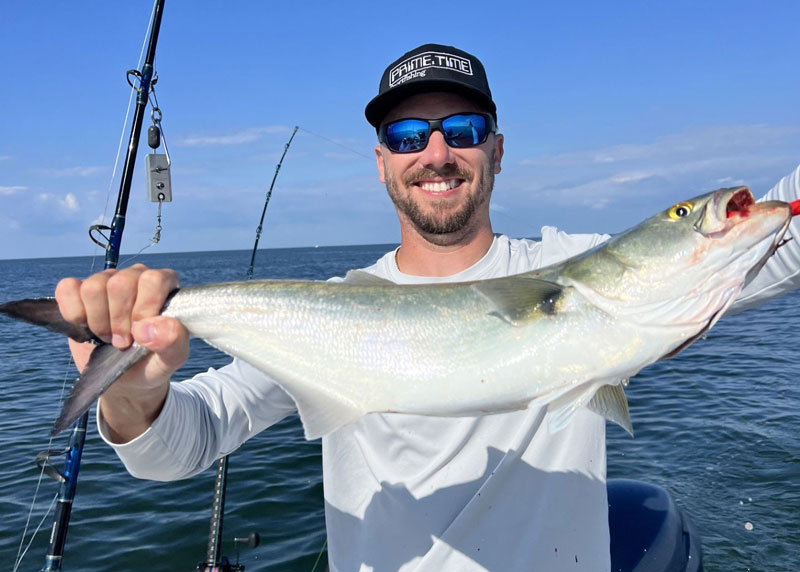
These days it’s a completely different story. Despite the striper’s difficulties they’re the dominant species in most of the Bay, especially north of the Rap, for most of the year. Bluefish, meanwhile, have tended to move around and assert their supremacy in scattered pockets in recent years. But one factor anglers dealt with way back when remains the exact same challenge in this day and age: finding and catching these fish can be tough during the midsummer months. They aren’t likely to churn the surface and make their exact location known until the early fall, so anglers may have to work a bit harder and plan a bit better to catch them.
Finding the Bluefish
When it comes to finding midsummer bluefish you know what we’re going to suggest first, right? Subscribe to the FishTalk fishing reports, and every Friday by noon you’ll get the latest intel on the fish’s whereabouts. Beyond that, your best tactic is a simple one: start trolling.
Trolling allows you to cover lots of ground, and if you don’t know just where the fish are holding you can pick out a long flight plan and test a wide swath of water. Rather than choosing a spot to stick with, ID a long troll which will take you through mile after mile of potentially productive areas. An example: say you know there have been fish along the east side of the middle Bay. The Stone Rock would seem like a good bet, but rather than trolling back and forth across it all day, circle it two or three times and if you don’t get any bites, head south and plot a course that takes you along the drop-off to the west of Sharps Island, over the Gooses, then down along the channel edges off Taylor’s Island. Cover lots and lots of ground until you get hits. When you do find some action, stick with the area. And if you don’t, continue on.
Wait a sec—what if you’d rather cast to the fish with light tackle? Fine. But it’s still a smart move to start out by trolling until you find some fish. If you aren’t geared up for trolling you can troll diving plugs on your light rods (although this will force a reduction in speed, which means covering less territory). Yes, you’ll occasionally get lucky and the fish might decide to break water for 15 or 20 minutes when the tide’s just right, giving their location away. But the rest of the day you’ll likely be spinning your wheels if you don’t nail down their general location by trolling, first.
Of course, seeing a knot of boats trolling around a spot is another form of giveaway. And bluefish do often hang around structure, like last summer when they staged for a while south-west of the Target Ship where there’s ragged live bottom, or when they were found around the wrecks in the Tangier. So, no, you don’t have to troll. But if you’re looking for the number one way to nail down the fish’s position when there aren’t visual indications, this is it.
Snapper Bluefish Snapping, Chopper Bluefish Chopping
While trolling it’s a good idea to set out a mix of spoons and hoses. Blues like both, and having both in the mix means you might also trigger an attack from a cobia, a bull redfish, or some other unexpected bonus species. Make one of the spoons a small one and Spanish mackerel become a possibility, too. You can run them behind planers or inline weights, at speeds in the five- to six-mph range.
A nice summer mix starting point for targeting bluefish with an outside shot at those other species might include, for example: a pair of size 3 Drone spoons run with eight to 12 ounces of weight inline; size 0 and/or a size 1 Clarkspoons run behind #1 planers; and 18” red hoses run behind #2 and #3 planers. Mix and match and alter the assortment based on the results or lack thereof.
When you have a good idea of where the fish are located and want to cast and jig versus troll, stick with spoons, hard baits, or tooth-proof plastics. Throw a regular soft plastic within a mile of a bluefish and it’ll come back tail-less. Even using tooth-proof lures you’ll hook-set with a whiff every now and again and reel back an empty leader, because if the bluefish strikes a lure as it falls it’s not uncommon for them to inhale it headfirst and get the leader between their teeth. Using longer, slender offerings (like a one-ounce G-Eye Rain Minnow) or adding a four- to six-inch trace of wire or knotable titanium leader will help reduce the bite-offs.
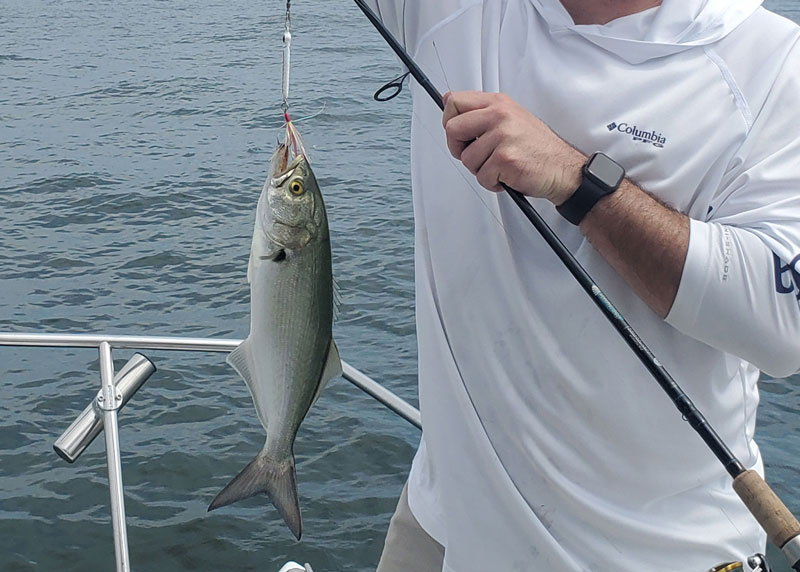
Hard plugs can also be killers on bluefish, both topwater and divers. Loud chuggers can bring the fish up top, too, so when you see marks 10’ or 15’ down don’t hesitate to try throwing goodies like Atomizers, Hogy Franken Chugs, or Yo-Zuri Mag Poppers. Work them as vigorously and as loudly as possible to grab the fish’s attention from afar. If you choose one with a nice finish, just be forewarned that after a few attacks from chopper blues it may look like it went through a meat grinder. Because it did.
As we go to print it’s too early to say just how good the bluefish will run in the Bay this summer nor just how far north they’ll trek, but thus far the indications are pretty encouraging. Still, we certainly don’t expect them to invade the Chesapeake in the numbers they once did. But one thing is for sure: if you can find ‘em when their presence isn’t obvious, midsummer fishing just became a whole lot more interesting.
Blues as Table Fare
Many people say they don’t enjoy bluefish on the plate, but this is often the result of the subpar harvest practices. Their oily meat doesn’t freeze well and blues should always be cooked when fresh. Bleeding them immediately after bringing one aboard has a big impact on the meat’s quality. And don’t let them sit for one minute without being on ice because they do spoil rapidly in the summer sun. Finally, the blood line running down the center of the fillets is very strong and cutting it out improves the meat’s flavor quite a bit. Even when taking all these measures bluefish of just a few pounds or less tend to be a lot better than choppers, which many anglers prefer to release.