You say that you want to enjoy brisk action on largemouth bass this winter? Sure, the bite slacks off in the bitter cold, but as long as the water’s surface doesn’t go from a liquid to a solid you can still get fish on the line. Largemouth bass will feed all winter long, especially during sunny afternoons when water temps rise up a few degrees and they feel the urge to eat. If, that is, you tempt ‘em just so.
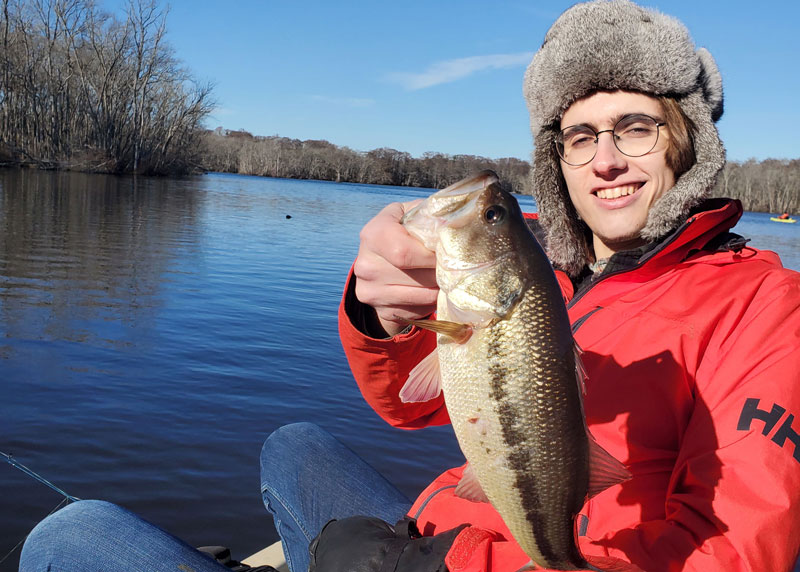
Winter Bass Fishing Option #1: Do the Drop-Shot
Drop-shotting lets you slow your presentation way, way down, which can be critical to getting hits when the water temps are low. Rig up a drop-shot (a weight at the end of your leader with a hook a foot to 18” up the line, either on a dropper loop or a drop-shot hook/swivel rig) with a relatively small #1 or 1/0 hook and a half-ounce or so of lead. For your offering stick with relatively small plastics, like a three- to four-inch fluke, worm, or Gulp! minnow.
Cast the rig near structure, channel edges, and drop-offs along points, remembering that when it’s this cold out the bass will often be found relatively deep. Use very slow, deliberate lifts of the rod tip to move the bait along, and let it sit for several seconds before moving it again. You want that lure to lumber along rather than hop. Bites will usually be subtle in nature and will consist of a single bump or tug—when you feel it, set the hook immediately.
Winter Bass Fishing Option #2: KISS Bass Fishing
One of the simplest methods of bass fishing is also one of the most effective when the fish’s metabolism has slowed and ice starts forming along the edges of the water: put a minnow under a bobber or on a bare hook weighted down with a split shot. In waters of 10’ or less the bobber is usually the way to go, and in deeper areas, cast out the minnow weighted down with a split shot and let it sit. You can also lip-hook the minnow on a marabou jig or small bucktail.
The method works from shore or from a boat, it allows you to hang your offering in a likely-looking spot indefinitely, and you can try it with just about any sort of gear. This is about as simple as bass fishing gets, but it’s also a highly effective way to get bass on the line during the coldest months of the year. It will prove particularly effective in fresher areas of tidal tributary rivers and in the Eastern Shore millponds.
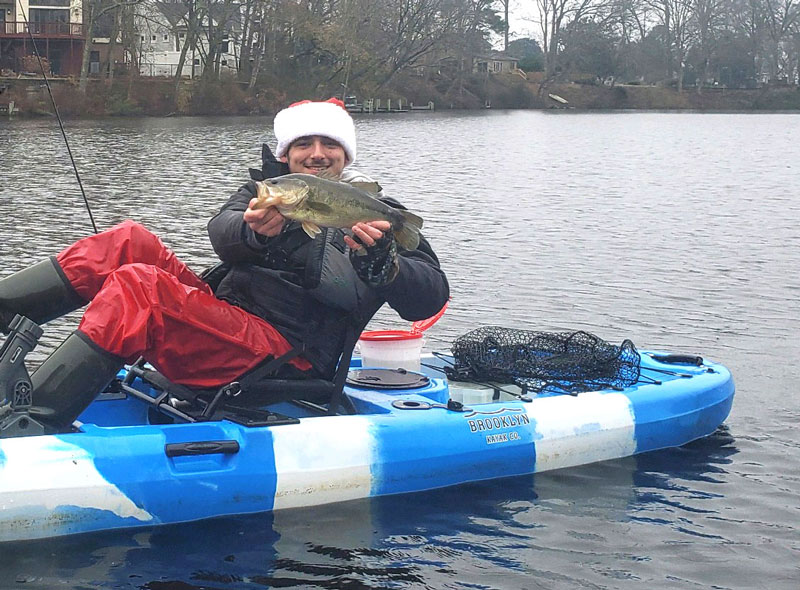
Winter Bass Fishing Option #3: Be a Jerk
When bass get lethargic fishing jerkbaits, especially suspending jerkbaits, can work magic. The combination of an erratic swimming action matched up with pauses where the lure neither sinks nor floats is often exactly what it takes to trigger bone-crushing reaction strikes. Choose a color pattern that matches up with the predominant prey species in the waterbody you’re fishing.
When winter fishing with jerkbaits remember that pausing during the retrieve is a key to success. In fact, it can be helpful to think of cranking the reel as a way to bring in slack, as opposed to reeling in the lure. Give the rod tip a little jerk back, then start counting in your head while bringing in slack and sliding the rod tip towards the lure. When most of the slack has been taken up sit tight for a few more seconds. Initiate the next jerk while there’s still a hair of slack in the line to impart the most erratic action possible, then go back into crank-and-pause mode.
When the water is in the 40s you’ll usually want to let the lure hang motionless for at least a five-count, and in the very low 40s or upper 30s, as much as a 10-count. If you get bites at the very end of the count, extend it a bit on future casts. If a fish strikes at five, for example, make sure you go to seven or eight from then on. Also remember that strikes during the pause are likely to be subtle. If you feel a little bump or twitch while pausing, set the hook immediately.
We may think we have it cold here in the Mid-Atlantic, but there will be anglers catching bass far to our north right up until the water’s surface firms up. As long as your casts end with a splash instead of a thud you can get those fish on the line—and these three methods top the charts for winter bass fishing.